

Each designer has to work with what they got, for Michael, passive must be better for his designs.
Active Speakers Better? No, per Michael Borresen
The best sounding speaker I have had the pleasure to hear is made by Borresen.
I recently spent time with Michael Borresen in Seattle at a show. It was slow so
I was able to speak with him for a time. I asked him if he plans an active speaker.
His answer was a definitive and immediate "No". He said separates sound better.
His statement flies in the face of what passes in most audio corners as commonly recognized facts.
Sadly I am too technically challenged to convey any of his further explanation.
I invite all intelligent commentary on this question. Theoretical or not.
- ...
- 75 posts total
To put it bluntly, passive crossovers are crude. That's why some sophisticated audiophiles prefer no crossover loudspeaker designs. A line level crossover can be much more precise while doing less damage (adding distortion) to the music signal. Couple a line level crossover with multiple power amps and it's possible for the designer to have more control over the final sound. The synergy is built into the loudspeaker and the audiophile doesn't have to search for some magical pairing of loudspeaker and amplifier. Active loudspeakers definitely have the potential for better sound compared to passive designs. |
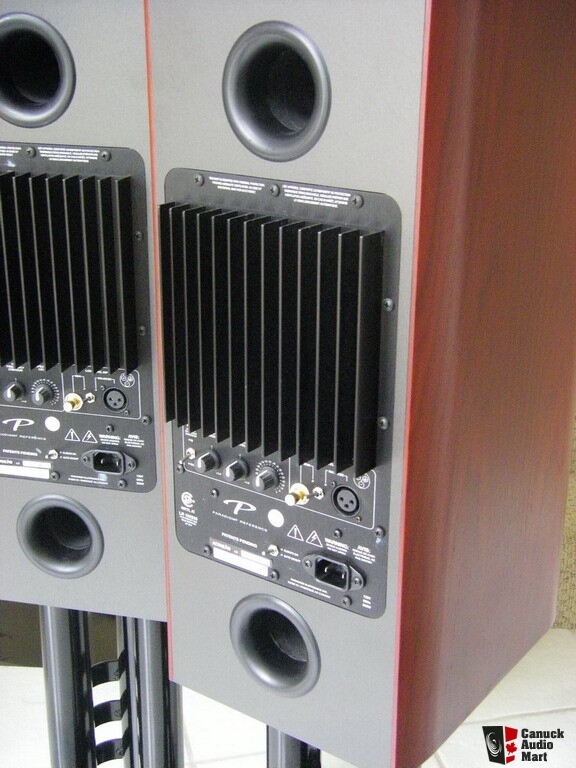
@invalid , the active speakers have the amps inside, like a studio monitor. They have both XLR and RCA inputs, a high pass filter that can be engaged when using them with a sub, and knobs to adjust the volume and contour bass and treble. The controls are useful to really dial in the speakers when you place them. The center height channel is connected to a Dayton monoblock with a crossover setting and volume control. This helps me blend it the the active center channel. Here is a shot of the amp on the back of all the active speakers:
|
- 75 posts total