How important is low W & F performance anyway?


I recently completed work on a direct drive motor controller for a turntable mfr with IMHO, rather impressive results (0.004% 2 sigma method, 0.002% RMS).  In measuring other tables actual performance (vs published specs) I was shocked at the rave reviews two tables received that have rather lousy measured performance (but impressive specs).  It made me wonder whether the goal of ultra low W&F performance was really necessary?  I trust the measurements as they were verified by several methods and software tools and they correlated rather closely, yet the reviewers almost universally praise these tables.  It made me wonder if the reviewers even know what they are hearing or listening for and not to put to fine a point on it, does it even matter? 

phoenixengr

@billstevenson 

I think Bruces comments above are informative in highlighting some issues where we can make big gains.

I do agree, I've always used solo piano as the hardest test for speed stability, wow etc - I grew up with a piano in the house played daily - issues to my ears on playback are obvious. It also highlighted to me in my early days that sprung suspensions were often detrimental to pitch stability, wow and flutter.

As a matter of interest my old Garrard 301 measures wow 0.04 & flutter 0.02, using the Shakenspin2, so I don't understand why any TT would measure 0.8.

My reference TT ( high mass thread drive, motor driven off sine & cosine generators plus stereo power amplifier ) is well below this level, and the improvement over the Garrard in pitch stability with the same arm/cartridge is very audible.
@billstevenson 

@phoenixengr 

"@faustuss There is no question concerning Bill’s credibility.  It makes no difference whether you find his information useful or not.  It certainly comports well with my experience and with what I have been learning since acquiring AnalogMagic.  Take it for what it is worth."

It did state early on that W & F is only going to be as good as what's on the master tape and what's introduced by the cutting lathe. So, this whole topic is rather mute.

If the OP wants to be disingenuous and insult the other posters in this thread's intelligence including yours it's his prerogative.

Am I supposed to be impressed that you spent good money on a software package called "AnalogMagik" when using tried and true methods of calibrating your equipment is more than adequate, I'm not!

"As I said, the choice is yours.  It hard to imagine how I could possibly care less either way."

Truthfully, I won't waste anymore of my time!


I agree with what's been said about listening to the LP/arm/cart as in the end, that is what we are doing.  But as an engineer working on a motor controller, my job was to make that contribution as small as possible.

Also agree that measuring it using an LP (and retail products) can give misleading results as Thigpen posited;  that's why I also chose to look at the encoders on these tables as it eliminated most of those issues.

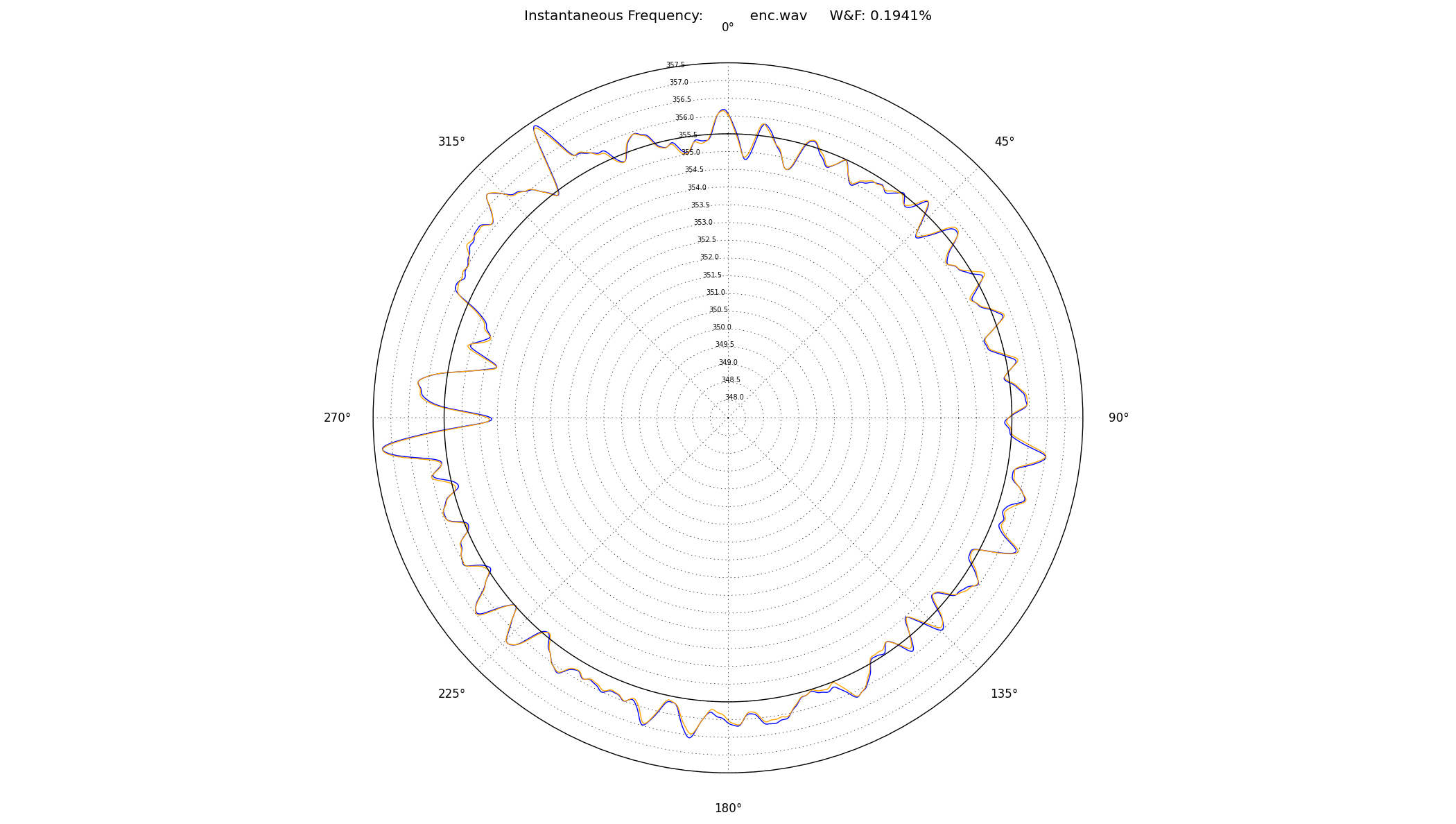
This is the polar plot of DD1 with a 40Hz BW;  W&F is 0.16%, still much worse than their spec of 0.008%:

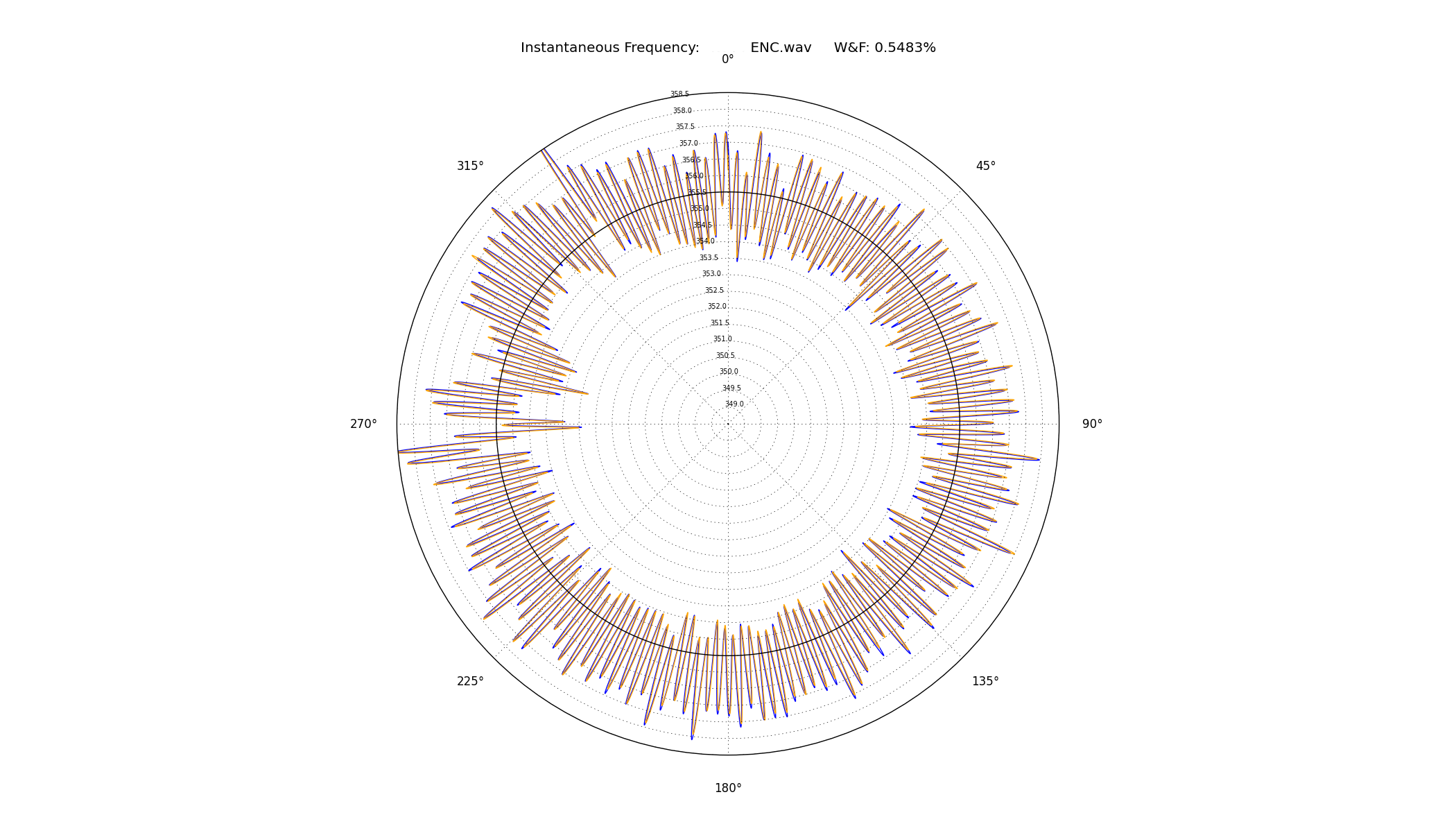
This is the same .wav file but with a 100Hz BW:


I

If you count the peaks there are exactly 20 from 0-45° or 225mS;  that yields a modulating signal at 88.88Hz or 160 pulses in 1.8S (360° or 1 rev).  This correlates with the 160 poles of the magnetic encoder they use.

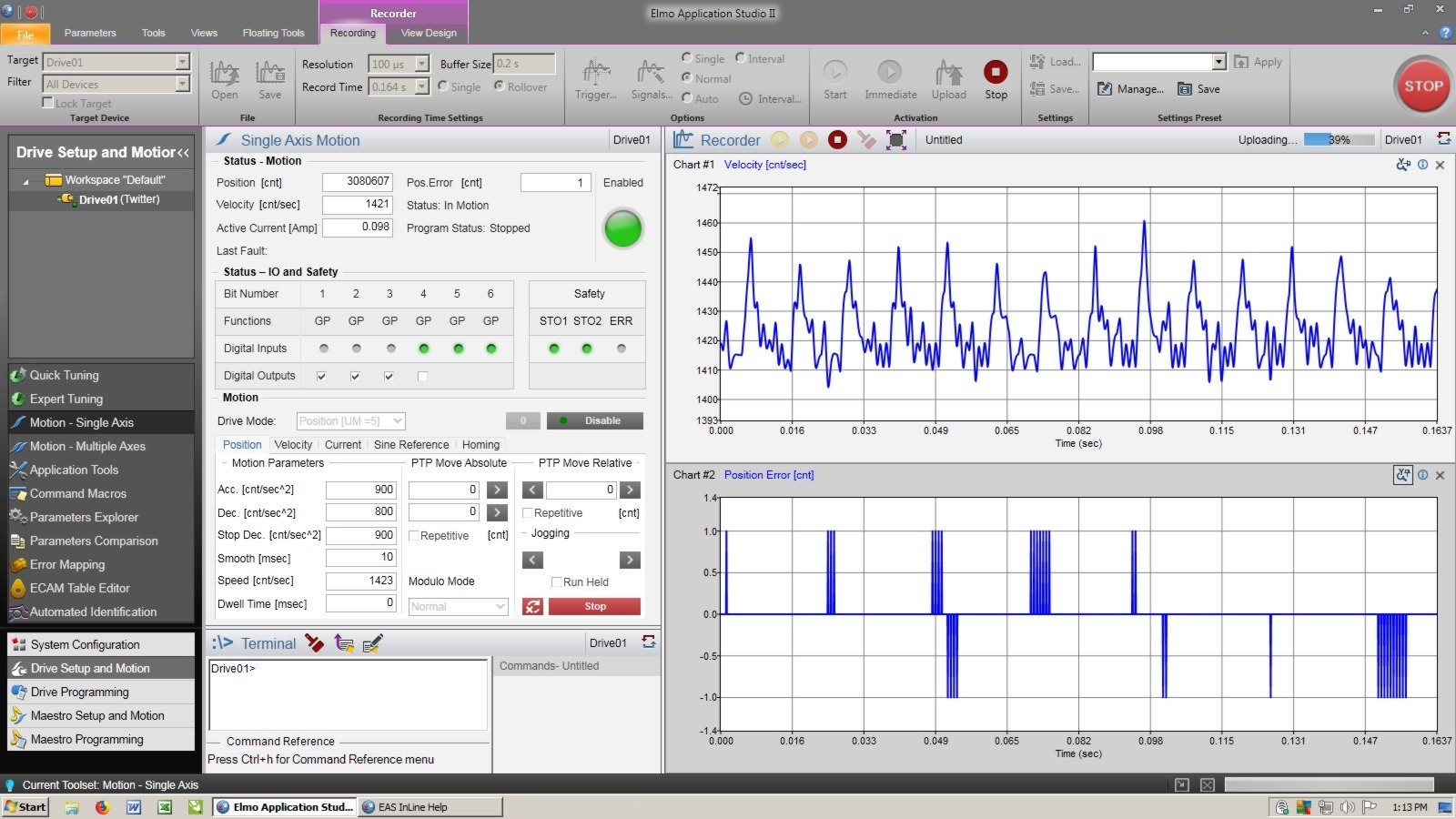
This is the readout of the development software used to program and tune the controller.  The upper right window shows speed error and there are ~13 peaks in 0.147 seconds corresponding to ~88.88Hz: