

@yogiboy said another way, my hesitation on the new stylus comes from doing the same previously with the Audio Technica SS445E/U and upgrading the original nude stylus to a LP Gear Shibata style stylus. I didn't like this presentation - it was too bright and fatiguing. Should i be concerned that sound signature came from the finer tipped stylus? Or was that more a characteristic of the AT cart?
New Cartridge or New Stylus
Dear all,
I’m running a Sumiko Oyster with the original stylus on a Project turntable. Curious what you think would have the greatest impact for improved dynamics and sound clarity for ~$150:
LP Gear ViVid Line Upgrade stylus for Sumiko Oyster Cartridge
or
Sumiko Rainier Cartridge
or
Grado Green3 Cartridge
Thanks!
- ...
- 25 posts total
I have LPs I bought in the 60’s, never properly cleaned until I joined the forum in 2019 Your LPs, especially previously played LPs must be thoroughly clean, all the way down to the bottom of the groove, I manually scrub the bejesus out of my old lps, and even I was shocked at how quiet they became and how much better they sounded. I have had to scrub some new purchases that arrived with noises.
Advanced Stylus Shapes are closer to the shape of the cutter blade that made the groove. They do not/should not touch the bottom, but they: go lower in the groove contact more side wall surface, some not previously contacted by prior conical or elliptical stylus, where no prior wear has occurred because the smaller contact surface occurred higher in the groove. Prior to cleaning, an advanced stylus can dig gunk out of dirty grooves, need cleaning very quickly. gunk that was always there, but the elliptical stylus did not get low enough to dig it out. The tremendous forces involved during play are more evenly distributed when you use a stylus shape with more sidewall contact, thus in addition to improved sound, you get less wear on the stylus itself, and less wear on the sidewalls of the vinyl. I also prefer a cartridge that tracks at a lighter vertical tracking force, as the wear is further reduced, i.e. 1.25g is 60% less vertical force than 2.0g. I/m opinionated, persistent, but not as much as this man whom I just met at the NY Audio Show, It’s a long slow video, but give yourself an hour, he’s pretty convincing I might use his mix and my manual scrub 2. KA-A-S-1: Spray Anti-static, anti-fungal 60 mL ( 2 OZ.) Spray/Surfactant with optician’s lint free cloth I did buy one of his brushes which he says, unlike most, is small enough to get in the grooves 5. KA-B1: Combination 1.5 M carbon fiber/ parastatic felt brush this is similar to the special ’show’ package and matches the price Charles was offering at the show
|
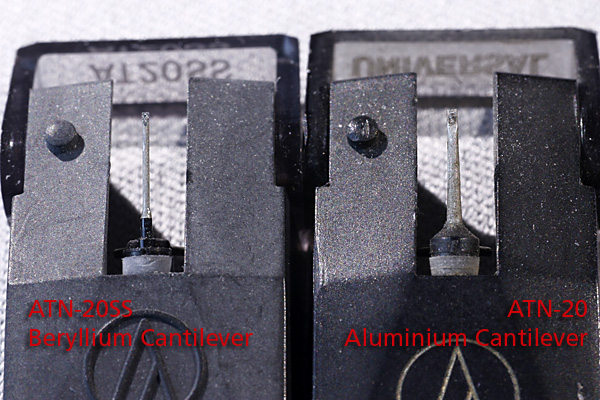
thought this photo was revealing, they are both tapered tubes SS is for Super Shibata
found this " by redskins15 » 20 Sep 2012 19:29 I think the at20ss is the finest cart ever made. Second would be a at155LC. They were made with beryllium cantilevers and that was the holy grail of material for cantilevers. The Federal government made beryllium a restricted substance because of toxic fumes that were lethal when producing it. Since then, cartridge makers have tried titanium, boron, etc without ever getting the results they could with beryllium. Shure V-15 type V, at20ss, at15ss and at15sa were made with beryllium. It can never be produced again and that is a loss for all vinyl lovers. Any cart with a beryllium stylus should be held onto or acquired as soon as possible as they will never come around again. I used to work for Audio-Technica but am now retired. The best will never come again...." "Oh, I left out the best ever produced because it slipped my mind. The Audio-Technica at160ML. This was produced in limited quantities and was a 24k gold covered beryllium cantilever with a shibata stylus. This was the finest we made and better than anyone else. It was the last one we produced when we got the federal mandate to stop making them. They made only 3000 cartridges so if you ever find one, I would seriously try to acquire it if in good condition. I would say that the AT160ML is priceless. Thanks again." "The reason was that the people who manufactured the beryllium were getting sick and dying. The federal trade commission as well as the EPA did studies and found that beryllium was highly toxic. They banned production of that rare earth element and subsequently was banned worldwide. The commercial use of beryllium metal presents technical challenges due to the toxicity (especially by inhalation) of beryllium-containing dusts. Beryllium is corrosive to tissue, and can cause a chronic life-threatening allergic disease called berylliosis in some people. So, the great Shure V-15 cartridge that everyone loved is no more, as well as the at20ss. at155LC and the spectacular at160ML stylus. When I was at AT, we were really hit hard when the ruling came down form the feds. We had been told earlier that it was likely to happen so we experimented with different alloys of boron and titanium, even manganese but nothing performed as well as beryllium. To most average listeners, many can’t tell the difference. Many others can make the distinction from beryllium and one made from boron. Well, we have a conundrum! During testing between boron and beryllium, we were able to get much better specs from Beryllium. For example, we could get channels separation levels of 35 on a atn-20ss and the boron would yield on 26. Frequency response for beryllium could be attained at 5-60000hz where boron could attain 20-25,000hz. Just by these 2 specs, we found beryllium to be a far better source for cantilevers than boron even when gold coated. I personally can hear the difference between the two types. It is great to see that many individuals such as yourself are happy with boron as we were very concerned that after beryllium was off the market, sales would go down and it would be another factor in the demise of vinyl. I suppose, in some cases, it was." " Post by lini » 22 Sep 2012 02:24 Wv: The beryllium cantilever on the ATN20SS wasn’t gold plated, unlike the one of the ATN160ML. But, afaik, even the ATN160ML just sported a rod type - while AT’s best ever beryllium cantilevers were gold plated, tapered tube types. And for Yamaha AT even made a diamond coated, tapered beryllium tube cantilever - to be found on the Yamaha MC1000 (while they chose a diamond cantilever for their own MC1000). Unmentioned is lighter tracking, the current AT Boron cartridges track at 2.0g; the earlier AT Beryllium tracked at 1.25g; the Shure microwall beryllium tapered tube tracked at 1.0g. |
- 25 posts total