

What building my own speakers has taught me...


Hi Everyone,

After 8 years or so I have finally finished my "reference" speaker system.  I say eight years because what started as a small, high end 2-way has morphed into a 3-way active system.  Really happy with the results for myself... but I wanted to step back a little and reflect on the audio industry right now. 

First, I’m not here to convince you to DIY your next pair unless you NEED to build something.  And I’m not here to rail against the high price of gear, which does have some merit.   Mostly what I think about is how difficult it really is to make a business selling audio gear, and that I’m actually SHOCKED at how many companies attempt to do so, and even more when they thrive. 

Pricing out all the components in my speakers I come to a total parts cost.  Lets say it’s $1,000.  It could be $10, the actual amount doesn’t matter, but pretend it’s $1k. If I try to imagine "How would I take this product to market?"  I simply can’t get to a selling price under 15 to 20 times manufacturing cost. 

At the same time, the cost of the average "reference" speaker over the last 20 years has really skyrocketed, while the audio enthusiast market has dwindled.   Then along came HDMI whose ridiculous licensing and technical requirements seems to at least have been partially responsible for Meridian and Theta Digital dwindling from the market. 

I can’t imagine how hard it is for anyone besides say Sony or Harman or Samsung to be in the market for audio gear.  Increased costs, high competition, dwindling consumers.....  are we in a bubble or does every generation think "this is it, this is the end of high end audio?" 

erik_squires

@ticat 


Do you already have ideas on any “improvements “ or design changes (just in case you had the crazy idea of doing it all over again)?  

I have actually thought about this.  Honestly my current speakers are too good for my room and better than I can hear, so I have no practical reason to change a thing, but thinking as a tinkerer I do.   I'm not going to claim my speakers are better than any others, but that they make me extremely happy and if that for me, in my room, my own ears are probably not good enough to hear better.  If I were to move to a home with a bigger/better living room that may change. 

A Little History ... 

An active three-way speaker was not ever the original plan.  A high end two-way with subwoofer support was, so if I were to start with a blank piece of paper and re-do this speaker as a three way to start there are some changes I'd make.

First, I'd change the tweeter.  It is excellent but when I purchased it around 2017 I might have been on the leading edge of it's adoption, and it was half the price (I think).  Now, megabuck speaker makers use it, like this $85,000 Gryphon: 

And while it is stellar, it is not 3x more stellar than a number of high end domes.  So I'd probably give up on the $850 Mundorf, or even the smaller version which is ahem, only $450.  The equivalent Beymas are also about the same.   Per ChatGPT, Mundorf probably started AMT tweeter manufacturing around 2004.  Not sure when this particular model was first released. 

So, first thing that would go is the tweeter.  A dome or ring radiator, probably not Be.  Next, since I'd have to raise the crossover from 1.8 kHz to 2.5 kHz I'd consider downsizing the mid-woofer to a 5" to get the same horizontal dispersion.  Further, the large size of my current top cabinet can be cut in half by the change in driver and using a sealed cabinet. 

I think this would  give me equivalent performance, with a much smaller cabinet and about 1/3rd the part cost.  laugh

The woofers are really great.  I could go with single, ported, but honestly I prefer output to extension, and for the money these are just really outstanding performers.  I could spend 2x as much and I'd probably never hear a difference. 

Lastly, if I was a truly rational man, and I'm not, I could probably also cut down on the plate amplifier power, and get the next size down.  In my modest 14' x 20' living room, 600 watts per channel, in a tri-amped set up is serious overkill. 

Of course, I just built these, in six months who knows how I would feel? 
What is your impression of the sound from your speakers in their current, active configuration vs. their earlier, passive state? I’m assuming you only used the top section with the Scanspeak woofer/mid and Mundorf AMT unit passively (powered by the Luxman?) with the dual 10" Dayton woofer coming in later actively, but maybe you are still able to discern some overall differences here. 

@phusis: 

What I can say, without a shadow of a doubt, is that the crossover type did not matter.  None of the alleged pluses/minuses about noise and distortion in one versus the other have appeared as I transitioned.  So I call all the prior debates on A’gon on one versus the other more or less bunk.  A good crossover is a good crossover regardless of active or passive, but of course, the power and dynamic range benefits of active are present, but in a modest living room, where I probably never put out more than 20 watts I don’t know if it will ever matter.   

I mean, yes, I can do the math and I can get 110 dB at 1m now, but ... will I care here?  Probably not.  Also, the speaker now uses 4th order filters exclusively.   Do these  sound terrible?  Or great?  No, not really.  They do the job they are intended to and I just don’t hear a problem or drastic change except maybe off axis.  The low order filter debates also seem kind of meaningless to mea now. 

I think one thing that kind of generally stands out is that I designed the top section in a different room, and never achieved the same level of warmth, depth or bass since moving into this home.  The transition to active has not only added a lot of output but it’s allowed me to tune the entire speaker better for this home. 

I was also able to fix an oversight I was aware of from the start.  The low pass filter was too shallow, honestly, for great off-axis listening, which has now been fixed. 

These are now my second major active project, and I can honestly say I don't ever see myself making a passive crossover again.  It's too big of a PITA, with too expensive parts and too much soldering/wiring.  The relative ease of designing with DSP crossovers has completely won me over with no real down sides.  

The one thing I feel in my system I want to change though is I do think it would benefit from a juicy tube preamp to drive them.  The loss of the Luxman integrated in the chain is something I feel when listening to music. 

I used to sell Hewlett Packard computer systems to the Navy. When a customer asked me what database to purchase, I said I hate the Oracle sales people and their company's tactics. I thought Ingram was a better database at a more reasonable price. But I suggested that they buy Oracle because I thought it would be around in the long run and Ingram would not. Databases need upgrades, service, etc. And getting off your database is as complicated as changing your operating system.

I just spent a lot of money on a pair of speakers made by Sonus Faber. When you buy speakers from a dealer, he takes 40% of the profit. Why pay for all of this overhead? 

First of all, if you're going to buy a new pair of Sonus Faber (or any other brand name speaker) it's going to have to come from a dealer, who takes a certain amount of responsibility for the speaker. 

But why the high retail price? Because when you purchase a decent speaker from a decent manufacturer, you are not just paying for the cost of supplies. Remember high-priced people have to put those speakers together. My speakers have wood cabinets in lute shape, and not just any fool off the street can do that kind of woodwork. 

I purchased the Olympica Nova 5 speakers. Prior to the Olympica Novas, Sonus Faber sold Olympicas. The Nova stands for all the work they put into redesigning their new line. That means when you buy from a manufacturer, you're also paying for their research-and-design team. Etc., etc.

I would not buy any audio gear from a guy who made it in his garage, no matter how good it sounded. If something went wrong in a month that guy might tell  me to take a hike. Or, "Oh, yes, I'll fix it. Just leave it here in the corner of my garage." Months go by, and you get the picture. 

My suggestion: if you want a deal, buy used. Off Audiogon or other used suppliers. You probably won't get warranty support, but at least you'll have a company to talk to if something goes wrong. And a place to buy parts if you need to fix something.


"And while it is stellar, it is not 3x more stellar than a number of high end domes.  So I’d probably give up on the $850 Mundorf, or even the smaller version which is ahem, only $450.  The equivalent Beymas are also about the same."


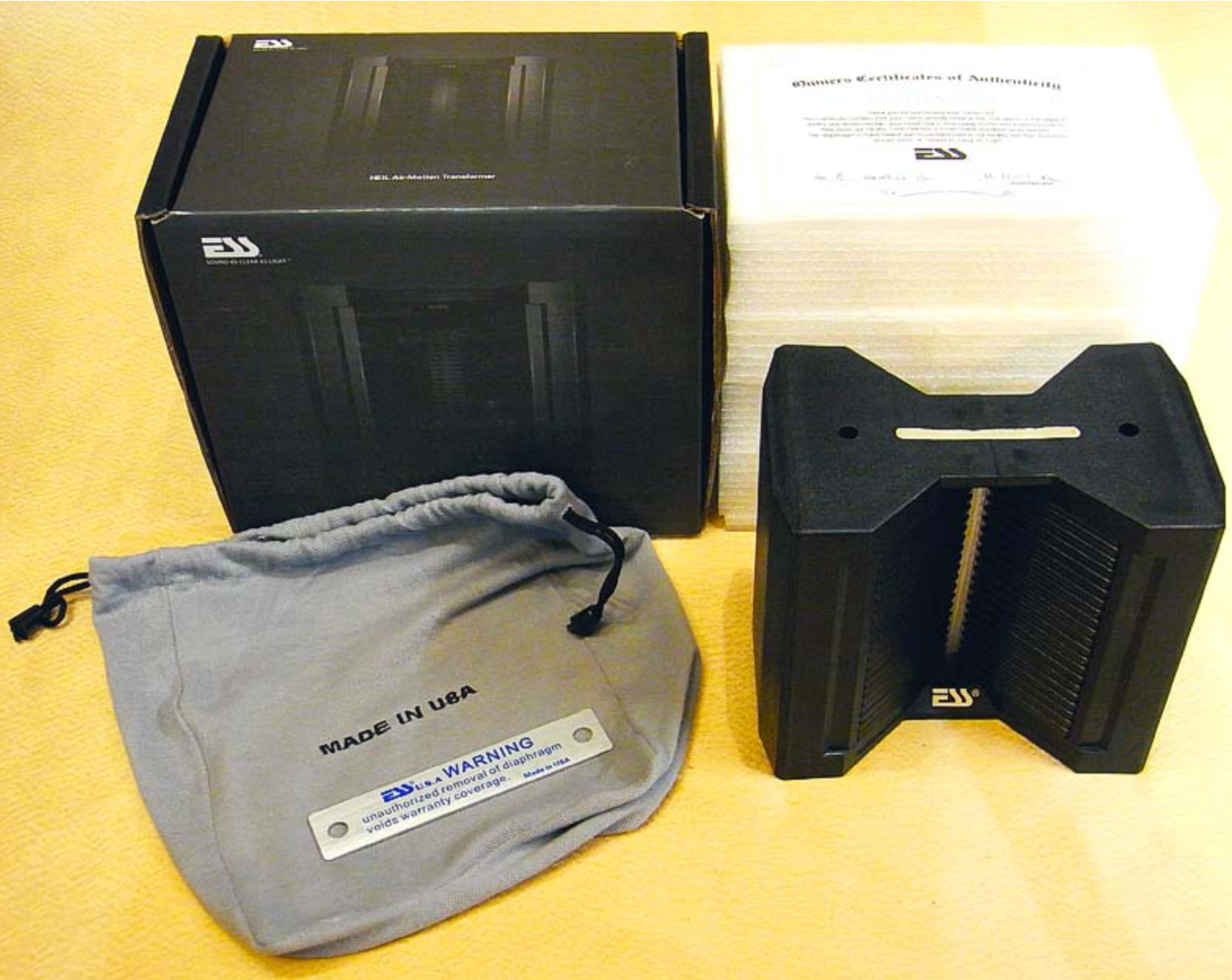
Do you realize that a set of "REAL" ESS AMTs sell for $560/pr and maybe a couple times a year (LIKE RIGHT NOW) they will list them for $250/pr, both with the mounting kits?  These factory sales go real fast and do not last!


I’ve modified mine adding wave guides and a rear reflector that completely changes the frequency response adding detail like you can't believe!


I would not buy any audio gear from a guy who made it in his garage, no matter how good it sounded. If something went wrong in a month that guy might tell  me to take a hike. Or, "Oh, yes, I’ll fix it. Just leave it here in the corner of my garage." Months go by, and you get the picture. 

My suggestion: if you want a deal, buy used. Off Audiogon or other used suppliers. You probably won’t get warranty support, but at least you’ll have a company to talk to if something goes wrong. And a place to buy parts if you need to fix something.

@audio-b-dog 

Respectfully, this is nonsense. 

High-end audio manufacturers go out of business all the time. What happens if "something goes wrong" then?

When they don’t go straight out of business, companies get bought out by new owners who want nothing to do with legacy products. What happens if "something goes wrong" then?

Even if none of the above happens to a company, their parts inventory isn’t inexhaustible. Many smallish speaker companies commission small runs of lightly customized drivers from reputable makers like Scanspeak. They’re based off regular Scanspeak models, but the off-the-shelf Scanspeak equivalent doesn’t fit and / or doesn’t sound right. 

Try to get replacement ProAc drivers from ProAc for 20-year old ProAc speakers. Either they’re long since out of stock, or it’ll be $750 a pop. Not that you’ll ever know though, because their inept, useless US distributor will not return your calls.

You, in fact, stand a much better chance getting DIY speakers fixed, because the builder surely used off-the-shelf drivers and parts, and those remain in the supply chain for decades.

Some DIY speakers are built by folks with decades of experience, six-figure workshops and raging OCD. Their end product rivals almost anything Sonos Faber ever made, minus the lute shape and Miami Vice high-gloss epoxy varnish.

Then again, some DIY speakers are just dumpster-ready junk that sounds like trash. Or, they may be anything in between.

If you and your ears can’t tell the difference, then you’re clearly better off buying brand-name speakers from a dealer at full retail.

But don’t dump on DIY speakers in a thread that was started by a DIY builder to share his pride in the speakers he built with his own hands.