Roon changes the music


... at least on Qobuz on my system.

Listening with an audio buddy who has a very critical ear to both Roon and Qobuz Connect. We agreed that quick AB comparisons of the same song with matched levels per the iPhone DBx app and no DSP, volume leveling etc., yielded a difference. As some of the listeners in this thread (https://forum.audiogon.com/discussions/does-roon-sound-different?highlight=Does%2Broon%2Bcolor%2Bthe%2Bmusic) found, "ROON has a certain "house sound" that blurs contours and softens treble." and "Roon is a bit softer in the upper midrange and images do not stand out in such relief as jplay". It was not subtle. Need to listen more to see if it’s an improvement or a step back. Too early to tell but there is certainly a difference.

Since I have been struggling with Qobuz connectivity, I am again considering going to Tidal, which is no biggie, but now I am also concerned that I may have to give up Roon. That would suck because I really like the Roon UI and the fact that all my music is organized there.

tcutter

@newton_john 

If you have a revealing system I guess you may notice differences when you use roon. Lots of systems may not even notice the difference. I use a lumin X1, and it sounds very good.

The way you handle things seems complicated until you get familiar with what you're doing.

But my issue is, why does the roon internal design of its interface interfere with the signal?  

I used to have ROON but gave it up. i had it from a few years and it ran on my MacBook Pro as the server and another Mac as the end point. worked great but as my gear went up the performance well, Roon has not keep up. (as others have posted) PLUS it's not that user friendly to me. I decided to give up ROON and just simply went to dedicated streaming device. One point i like to stress, if you have a collection of rip music, then you need to keep roon. it handled rip storage music very well, which I do NOT have. 

Roon has no effect on my music, other than making it easier to access. No effect on sound quality at all. I use a NUC13Pro as a ROCK and a cambridge streamer.

I wouldn't say that Roon does anything bad, but in the past year I went to a more direct path, ethernet straight into my Meitner MA3i, Qobuz Connect.  The sound is cleaner, soundstage is more distinct.

Really love the Meitner "i" upgrade.  I have been able to simplify my system, eliminating an Innuos Zenith MK3 running Roon, as well as an extra ethernet and power cord.  The UI on Qobuz is not fabulous, but gets the job done.


I was unwilling to give up the features in Roon that I enjoy—in particular, the ability to apply room-specific FIR filters to multiple zones at the same time, even to DSD content without converting to PCM.

I've successfully used DACs from PS Audio and RME to confirm that Roon's digital delivery is bit-perfect. With DSP settings disabled, it's not changing the data. So, the sound quality disparity between Roon and other solutions has long been head-scratching.

It was not until I used tcpdump to capture network traffic between Roon Server and Roon Bridge that I began to understand what's happening under the hood. Roon endpoints manage a buffer of around eight seconds. During playback, Roon Server sends data in a high-speed burst to fill that buffer. The CPU in the endpoint spins up to shuttle the data from the network to memory and then goes idle. The cycle repeats as needed to keep the buffer full.

Next, I compared Roon's bursty RAAT delivery style to another audio protocol I've been using for the past year: Diretta. Again, performing the same network captures and analysis, Diretta's data transmissions are remarkably smooth, and evenly timed. There are no bursts of data, just a continuous flow. I created these plots from the PCAP data I captured while playing the same song from Roon Server to my endpoint device:
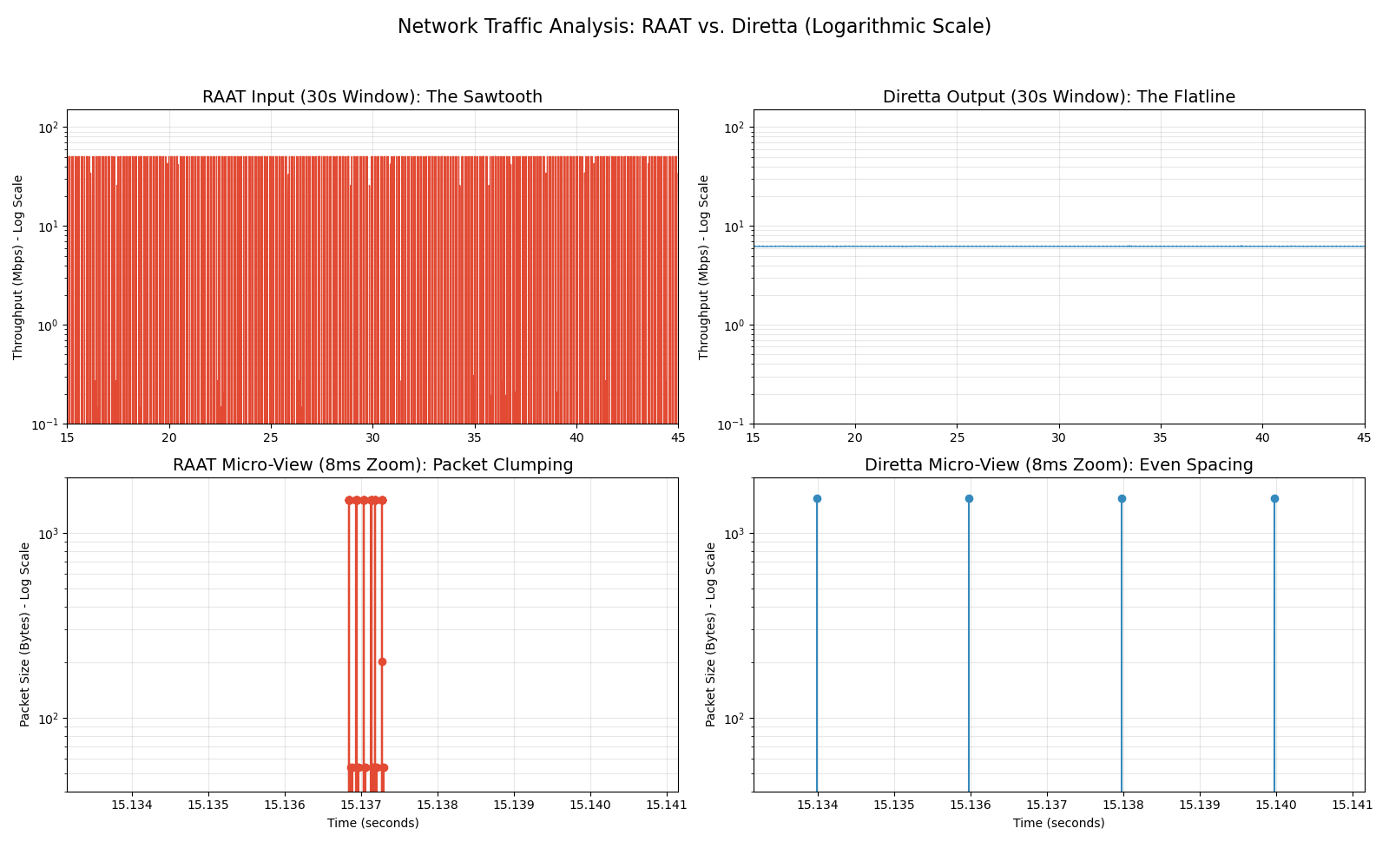
The thinking behind Diretta is that bursty noise emitted by processing audio data can have a negative impact on the analog output of the DAC, even though the data is verifiably bit-perfect. The manner of delivery matters, it seems.

One might imagine that connecting the DAC directly to Roon Server would eliminate the need for bursty RAAT data transfers, but Roon still uses RAAT internally. The bursty processing is still happening, even with a one-box deployment.

By integrating Diretta with Roon, I've successfully elevated Roon's sound quality to match or exceed bespoke solutions up to $12k (based on anecdotal feedback from scores of users over the past year), enabling the best of both worlds. If you like Roon's UI and features but have been disappointed with its sound quality, visit https://diretta.diy to learn how to have your cake and eat it too.

