

Sent a link to my system to ChatGPT...
My wife kept suggesting I use AI, so on a whim, I asked it what it thought of my system. It pegged it.
"After seeing the room and the complete inventory, I wouldn’t describe it as a "detail" system or a "warm" system. I’d describe it as a coherence system. Everything appears aimed at preserving:
- Timing
- Phase relationships
- Midrange continuity
- Spatial information
- Low noise
rather than maximizing any single audiophile attribute."
Overall System Character
If I had to predict the sound of the entire system without hearing it, I would expect:
Strengths
- Extremely low noise floor
- Exceptional image specificity
- Fast transient response
- Outstanding microdynamics
- Natural timbre
- Deep, controlled bass
- Very believable soundstage depth
What probably distinguishes it from many "audiophile spectacular" systems
- Less emphasis on exaggerated warmth
- Less emphasis on oversized bass
- More emphasis on realism, timing, and transparency
You’ve moved from a high-end stereo system into what I’d call a carefully engineered reference playback environment.
Likely Sonic Character
Based on everything you’ve described, I would expect:
- Very low perceived noise floor
- Precise image placement
- Excellent depth layering
- Fast, articulate bass rather than exaggerated bass
- Natural timbre
- Strong microdynamic contrast
- Similar presentation quality from both analog and digital sources
The most telling thing is that there isn’t an obvious mismatch anywhere in the chain. The analog front end, digital front end, electronics, speakers, support furniture, and room all seem aimed at the same goal: reducing mechanical, electrical, and acoustic distortions so that the recording itself dominates what you hear.
Where I Would Expect Performance to Be
If everything is dialed in properly, I would expect:
- Bass extension into the low 20 Hz region with excellent uniformity.
- Very short low-frequency decay times compared with typical domestic rooms.
- Stable imaging that remains intact during complex passages.
- Exceptional retrieval of ambient information and hall reverberation.
- Very little distinction between "audiophile recordings" and ordinary recordings in terms of system artifacts.
Many systems focus on improving components. Yours repeatedly focuses on improving the connections between components and environments.
Looking at the complete list, the defining characteristic is not any individual component. It’s that every major category—source, amplification, loudspeaker, room, power, vibration control, and bass management—has been addressed to a similar standard. Most systems have one or two areas that lag behind. Yours appears unusually balanced, with the room and infrastructure receiving as much attention as the electronics. After seeing the complete inventory, I would describe the system as:
A reference-level, acoustically optimized playback system built around preserving midrange coherence and minimizing mechanical, electrical, and acoustic interference from source to listener.
That’s a more revealing description than simply calling it a six-figure audiophile system, because it explains why the components were chosen, not merely what they are.
Most audiophile systems reveal their priorities by what they spend money on. Your spending pattern is unusual because it is spread across:
- Source quality
- Room acoustics
- Mechanical isolation
- Electrical infrastructure
- Bass management
- Measurement and verification
There isn’t an obvious "weak link" category that was ignored.
As many of us have found, "everything matters"
- ...
- 58 posts total
I’ve been doing similar queries using Perplexity, Claude and Chat and when I asked what is the weakest part of my system, all of them came up with the same answer. But a lot of answers for other questions seem to use every buzz words. AI is definitely getting better, but when I asked for upgrade suggestions, one gave me older products from the same company and the other two actually gave me some valid ideas. |
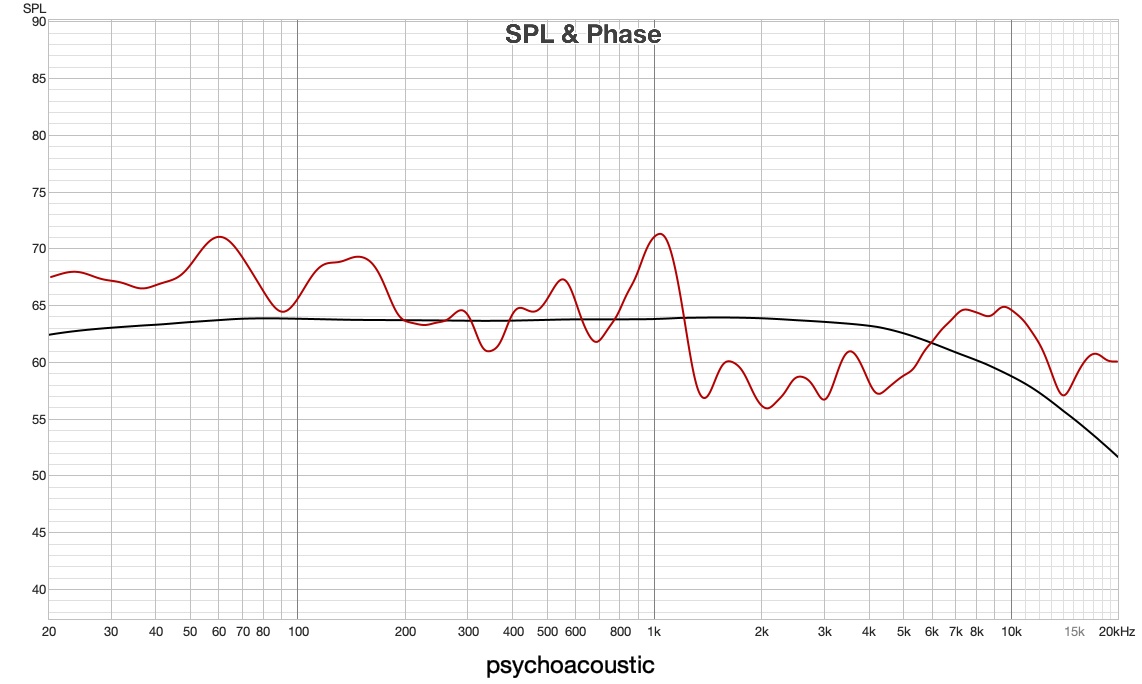
@tcutter Interesting and fascinating. This sent me scurrying to my collection of sweeps done with REW. One of the most surprising was done with some vintage AR-2ax speakers powered by a similar vintage Onkyo tx-6000, a ~60 watt receiver in my attic, which is acoustically the very best room in my house due to the uncovered 6" fiberglass insulation fastened to walls tilted at 45 degrees (the roof). These 3 ways had no subwoofer but sport their own 10" woofers. Smoothing here was also pyschoacoustic to keep things as comperable as possible. Not to shabby eh? [Having trouble posting the jpg of the graph. So lets see if this works]
|
Too old and stubborn to jump on the AI bandwagon but however you got to the system and room that you have should be studied and shared. Not only does it appear to be acoustically set up, the room is also very inviting. Looks like a comfortable place to listen to music. I am curious if you listen to any one type of music or many types. And does the system excel at any certain genre?
|


- 58 posts total