

"The reason is: the higher amplifiaction by MC phono-pres the higher distortions.
The ’’old Lukatschek’’ just produced the ’’younger brother’’ of Ortofon MC2000
called BENZ EBONY TR (TR for transfomer; output 0,1mV imedance 1 Ohm)..
Do members of Audiogon pretend to know better?"
The noise floor of vinyl is around 70 dB; most preamp designers have absolutely no trouble achieving that even at gain levels of 70dB or more. A couple cases in point.
Luxman E-07 phono preamplifier -
"In MM mode, the Luxman preamp’s unweighted, wideband S/N ratio, measured at the balanced outputs with the single-ended inputs shorted to ground and ref. 1kHz at 5mV, was a superb 81.6dB (average of both channels). Restricting the measurement bandwidth to 22Hz–22kHz increased the ratio to 84.6dB, while the A-weighted ratio was an astonishingly high 90.2dB. In MC mode, the ratios were approximately 9–10dB lower than in MM mode; this is still a very low level of noise. Spectral analysis of the E-07’s low-frequency noisefloor in MM mode ref. 1kHz at 5mV (fig.2) revealed that both the random noise and the supply-related spuriae were very low in level.
The E-07's overload margins in both MC and MM modes, ref. 1kHz at the standard MC level of 500µV and the standard MM level of 5mV, were excellent, at 28dB from 20Hz to 20kHz. The E-07 offered very low distortion. Fig.3
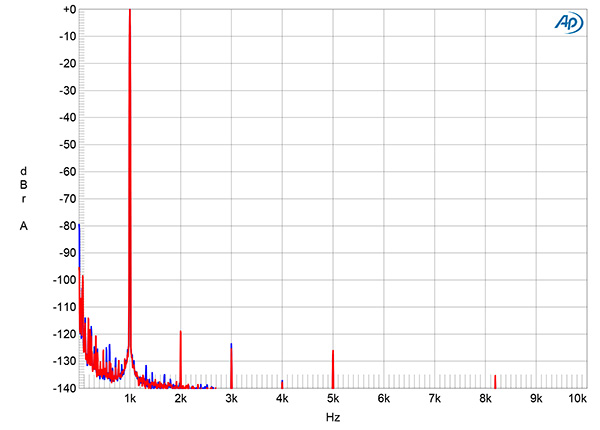
shows the spectrum of the preamplifier's balanced output reproducing 1kHz at a level just 6dB below the MM input overload voltage. The only distortion harmonics that can be seen above the noisefloor are the second, at –120dB (0.0001%), the third, at –124dB (0.00006%), and the fifth, at –126dB (0.00005%). These very low levels were identical when I repeated the analysis at the single-ended output; the second harmonic remained at the same level when I reduced the load impedance to the current-demanding 600 ohms, though the third harmonic rose to a still-negligible –116dB (0.00015%).
Intermodulation distortion with an equal mix of 19kHz and 20kHz tones at a peak input level 6dB below the MM clipping voltage at 20kHz was superbly low (fig.4).
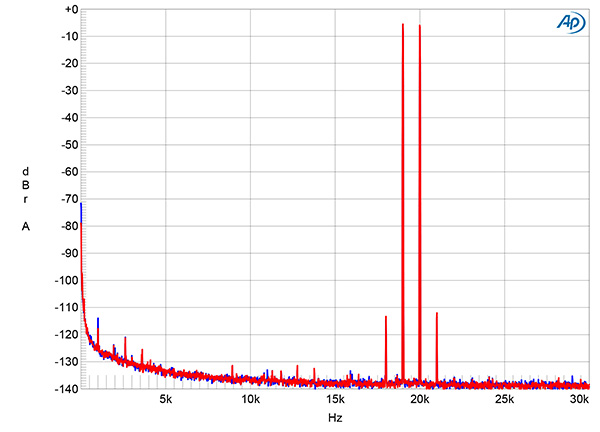
The difference product at 1kHz and the higher-order products all lay close to –114dB (0.0002%)." - John Atkinson Stereophile Magazine
Luxman EQ-500 phono preamplifier -
"With the inputs set to MM, the overload margin at 1kHz was excellent, at 30dB ref. 5mV, but this worsened at the frequency extremes, to 15dB at 20Hz and 12dB at 20kHz. The MC overload margins, ref. 1kHz at 500µV, were similar. Harmonic distortion at normal levels was low, at typically 0.05%. Spectral analysis (fig.3)
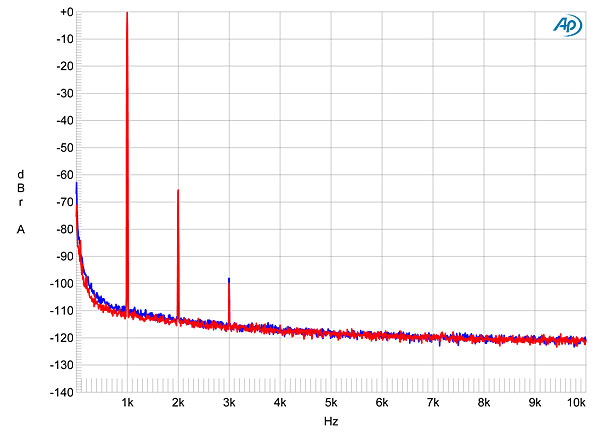
revealed that the primary harmonic present was the second, at –67dB. This graph was taken into 100k ohms; reducing the load impedance to a punishing 600 ohms increased the level of the second harmonic by almost 20dB—but the Luxman will never be used with so low a load. Intermodulation distortion (fig.4)
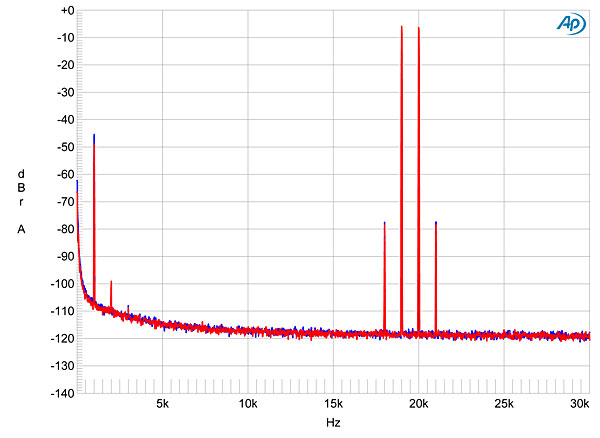
was a little higher than I would have liked to have seen, the difference product at 1kHz resulting from high-level tones at 19 and 20kHz lying at –47dB (0.4%) in the left channel and –50dB (0.3%) in the right. Higher-order products, however, are much lower in level.
With the EQ-500 set to MM (moving-magnet), the voltage gain at 1kHz was 36.4dB with the gain set to "36," 38.4dB with it set to "38," and 40.5dB with it set to "40." (A 1mV input signal was indicated as –20dB on the front-panel level meters with them set to Low, –10dB with them set to High.) With the phono inputs set to MC (moving-coil), the gain was 55.9dB (MC High) and 56.5dB (MC Low), but these measured gains were affected by the interaction of the EQ-500’s input impedance of 56 ohms (High) and 7 ohms (Low) with the Audio Precision’s output impedance of 20 ohms. Correcting for the voltage-divider action gives respective gains of 58.6 and 68.2dB, which are close to the specified gains of 55 and 67dB.
Almost no power-supply–related spuriae are visible, and the unweighted, wideband signal/noise ratios (ref. 1kHz at 5mV and taken with the inputs shorted to ground) were good, at 59dB in the left channel, 65dB in the right. An A-weighting filter improved these ratios to 77.2 and 78.5dB, respectively. Unlike that of a phono preamplifier with an active MC gain stage, the EQ-500’s noise performance was almost the same with its MC settings, due to the use of internal step-up transformers." - John Atkinson Stereophile Magazine
Please don’t make the assumption that this performance is strictly in the realm of components at this price level since if you do the research this can be achieved in other designs at much lower price points that can be utilized with phono cartridges at respectively similar value.