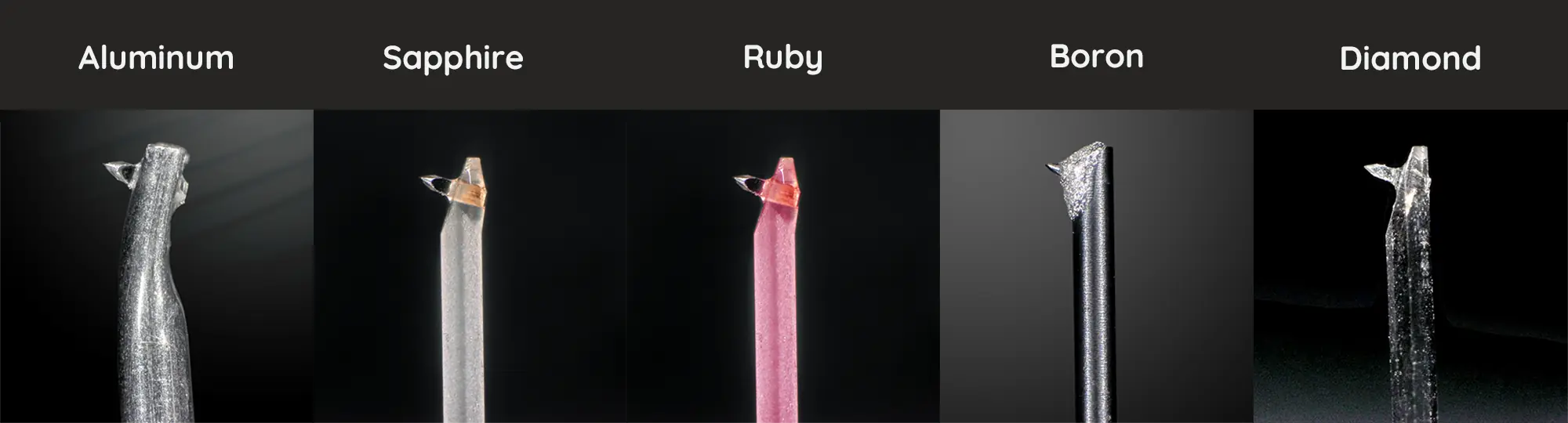
bill, lewm, everyone
OP has a high enough budget, I would want van den hul's advice about what to expect if .......
I was just wondering, what if we inadvertently occasionally get 'perfection' accidentally, and without knowing that, we think it always sounds this good, or, we get the best thing wrong and think, nothing special about ... diamond ....
I think I am gonna start using my two arm's 'on the fly' VTA, start learning to listen for changes, I have been using 'level' when down in the groove, good enough, leave it alone.
There is a certain relief when you don't try for perfection, but I just want to learn what I hear, I can always return to 'level'.
What CONTENT do you find revealing for Azimuth/Anti-Skate/VTA_____?
............................
the article above discusses shapes, and finishes with a suggestion to avoid the MicriRidge/MicroLine due to the difficulty of proper alignment.
"
Phono Cartridge Main Stylus Shapes
The shape of the stylus determines how much groove information is retrieved, how well the stylus tracks complex modulations, and how gracefully it handles wear — both of the groove and the stylus itself.
Broadly speaking, more advanced stylus shapes offer greater resolution and lower distortion, but often require more precise setup to perform at their best. One key factor is Vertical Tracking Angle (VTA): the more sophisticated the stylus profile, the more sensitive it becomes to VTA alignment for optimal sound.
Here is a comparison of common stylus shapes:
Conical (Spherical)
The simplest and most forgiving shape. The stylus contacts the groove at a single point, making it tolerant of imperfect setup. However, it cannot retrieve the finer details encoded in the groove, and high-frequency tracking is limited. Conical styli are well suited to casual listening and DJing with heavy back-cueing and even scratching.
Elliptical
A significant step up from conical. The elliptical stylus contacts the groove along a narrow vertical band, allowing it to trace modulations with better precision, particularly at higher frequencies. Good MM cartridges commonly use elliptical styli, offering excellent value and sound quality.
Hyperelliptical / Line Contact / Shibata
These advanced profiles extend the contact area along the groove walls, allowing the stylus to follow groove modulations with far greater accuracy. This results in lower distortion, improved tracking, and reduced record wear. However, these shapes are more sensitive to VTA and azimuth alignment, and require more careful setup to reach their full potential.
MicroRidge / MicroLine
Among the most sophisticated shapes available, MicroRidge and MicroLine profiles closely replicate the shape of the original record cutting stylus. They deliver exceptional detail retrieval, and extended frequency response. These profiles are the most sensitive to setup, particularly VTA, and are best suited to experienced listeners who can carefully fine-tune their systems.
Finding the Sweet Spot:
For many Analog Lovers, a Line Contact stylus strikes the ideal balance. It offers compelling detail retrieval and excellent tracking with significantly lower distortion than elliptical shapes, yet remains more forgiving in setup than the most extreme profiles. Properly aligned, a Line Contact stylus can deliver musical richness, resolution, and groove preservation that elevate the analog experience without becoming a chore to optimize."