

@elliottbnewcombjr I bought one of the ART 750 ANV cartridges after Mikey Fremer ran his comparison and it beat everything else. It had a diamond cantilever. It was a good cartridge, but in truth I preferred my 2M Black, which I recently up graded to a 2M Black LVB when it needed a new stylus. The ART 750 ANV is kicking around in a drawer somewhere, I've been kind of searching for it recently. I think the stylus is shot though. Anyway, if that world beater (yawn) is any indicator, a diamond cantilever is not so great. It takes the sum of all the parts to make a great sounding cartridge. It is not any one thing. And every taste is unique too.
Some help please with Cartridge choices
I currently am using a Van den Hul Crimson, which I really like, with my Nottingham table. I am likely going to get it retipped and then use as a back up. My dealer has recommended My sonic labs as a good upgrade, but they seem to be unobtanium currently. He floated the Hana Umami black as an alternative, as well as Koetsu and Air tight. I prefer a musical and less analytical sound, more rounded than sharp edges. The Hana is in the budget and available. Any thoughts? Thanks.
- ...
- 62 posts total
Wow Hana Unami Black is quite the recommendation. Starting you quite high...lol I was going to suggest the Benz Micro who have a good range. I am currently using a Benz Wood LPS paired with a Reed 2G Ebony tonearm on my TT Zet-3 and a Benz Wood SL on my Marantz connected on an MC high setting on my Phono preamp. Not sure what the actual quantitative measurement is though. LPS is good choice and could save a few bucks compared to the Hana that was suggested. I love the sound of Benz product as it appeals to me. I have used Ortofon but found that up and down the line, the sound to be on the clinical even a tad harsh sound compared to the much more musical and rounded characteristics of the Benz line. |
Bill, Don't know about your ART750ANV, but I have a Dynavector 17D3, which also has a diamond cantilever, however tiny it may be. I don't brag about the 17D3 here, but it is really great. I have had it on my Viv Float in my Beveridge system and now in a Reed 2A in my Atma-sphere/Sound Lab system. In each very different environment, it excels. I guess the current version is 17DX. I don't know the cost of the 17DX, but the D2 and the subsequent D3 were very good values at under $2K. I am not going to claim that the excellence of the 17D3 is due to its diamond cantilever, just offering it up as an example. |
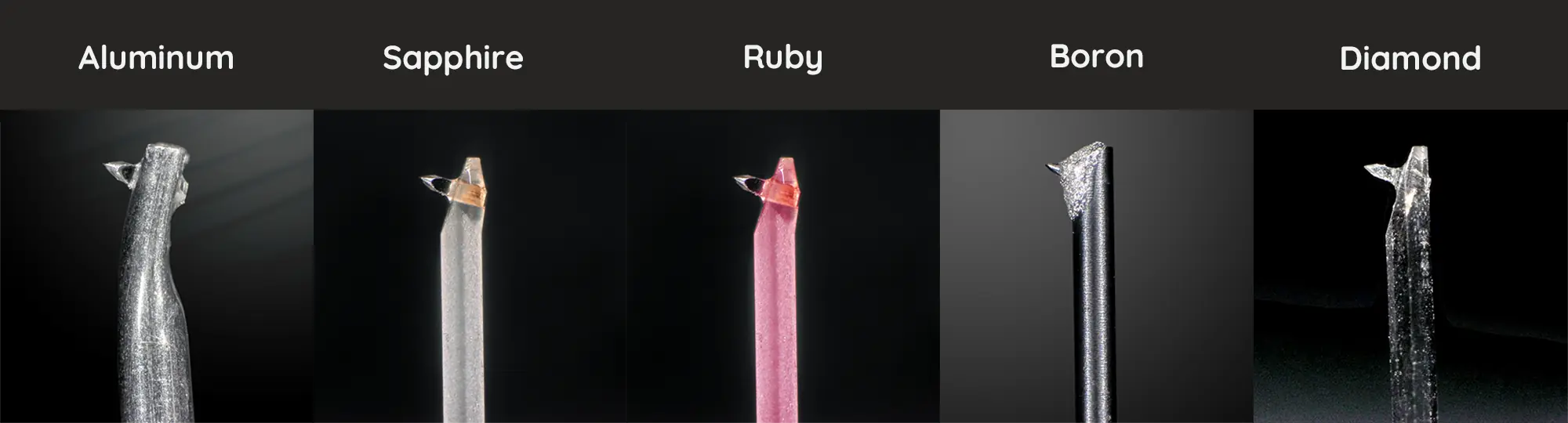
Just came across thishttps://www.leson.org/choose-phono-cartridge/ excerpt: "Cantilever Material Comparison
Phono Cartridge Main Cantilever Materials The cantilever acts as the mechanical bridge between the stylus and the generator system, transmitting the minute groove modulations with precision and speed. The choice of cantilever material directly influences the cartridge’s:
Ideally, the cantilever should be as light, rigid, and well-damped as possible, minimizing unwanted resonances and faithfully transmitting stylus motion to the generator. Here is a comparison of common cantilever materials: AluminumStill widely used in many MM and entry-level MC cartridges. Aluminum is inexpensive and easy to manufacture, offering good basic performance. However, it is relatively soft and can exhibit internal resonance and flexing, which may introduce subtle coloration and limit ultimate detail retrieval. SapphireExtremely rigid and hard, sapphire provides very high resolution and excellent tracking precision. However, it can sometimes lend the sound a slightly cooler or more analytical character, depending on the overall cartridge design. RubySimilar in performance to sapphire, ruby adds a subtle sense of crystalline precision to the sound. It is less commonly used today but remains a beautiful and highly resolving material in the right implementation. BoronBoron has become the reference material in many of the best high-end MC designs. It is very stiff, extremely light, and has excellent internal damping properties. This allows for fast transient response, clean articulation, and a natural tonal balance. Boron cantilevers offer an excellent combination of performance and practicality. DiamondAt the top of the hierarchy, a solid diamond cantilever offers unmatched stiffness, the lowest possible moving mass, and the purest transmission of stylus motion. It can deliver astounding clarity, microdynamic precision, and an uncanny sense of space and transparency. However, it is extremely difficult and expensive to manufacture, and is reserved for the cost-no-object phono cartridges. Finding the Sweet Spot: For most Analog Lovers, boron strikes the ideal balance. It combines exceptional rigidity and speed with musicality and ease of integration into a wide range of system designs. This is why it is the material of choice in many of today’s most respected high-performance MC cartridges, including those from Le Son." |
bill, lewm, everyone OP has a high enough budget, I would want van den hul's advice about what to expect if ....... I was just wondering, what if we inadvertently occasionally get 'perfection' accidentally, and without knowing that, we think it always sounds this good, or, we get the best thing wrong and think, nothing special about ... diamond .... I think I am gonna start using my two arm's 'on the fly' VTA, start learning to listen for changes, I have been using 'level' when down in the groove, good enough, leave it alone. There is a certain relief when you don't try for perfection, but I just want to learn what I hear, I can always return to 'level'. What CONTENT do you find revealing for Azimuth/Anti-Skate/VTA_____?
............................ the article above discusses shapes, and finishes with a suggestion to avoid the MicriRidge/MicroLine due to the difficulty of proper alignment. " Phono Cartridge Main Stylus Shapes The shape of the stylus determines how much groove information is retrieved, how well the stylus tracks complex modulations, and how gracefully it handles wear — both of the groove and the stylus itself. Broadly speaking, more advanced stylus shapes offer greater resolution and lower distortion, but often require more precise setup to perform at their best. One key factor is Vertical Tracking Angle (VTA): the more sophisticated the stylus profile, the more sensitive it becomes to VTA alignment for optimal sound. Here is a comparison of common stylus shapes: Conical (Spherical)The simplest and most forgiving shape. The stylus contacts the groove at a single point, making it tolerant of imperfect setup. However, it cannot retrieve the finer details encoded in the groove, and high-frequency tracking is limited. Conical styli are well suited to casual listening and DJing with heavy back-cueing and even scratching. EllipticalA significant step up from conical. The elliptical stylus contacts the groove along a narrow vertical band, allowing it to trace modulations with better precision, particularly at higher frequencies. Good MM cartridges commonly use elliptical styli, offering excellent value and sound quality. Hyperelliptical / Line Contact / ShibataThese advanced profiles extend the contact area along the groove walls, allowing the stylus to follow groove modulations with far greater accuracy. This results in lower distortion, improved tracking, and reduced record wear. However, these shapes are more sensitive to VTA and azimuth alignment, and require more careful setup to reach their full potential. MicroRidge / MicroLineAmong the most sophisticated shapes available, MicroRidge and MicroLine profiles closely replicate the shape of the original record cutting stylus. They deliver exceptional detail retrieval, and extended frequency response. These profiles are the most sensitive to setup, particularly VTA, and are best suited to experienced listeners who can carefully fine-tune their systems. Finding the Sweet Spot: For many Analog Lovers, a Line Contact stylus strikes the ideal balance. It offers compelling detail retrieval and excellent tracking with significantly lower distortion than elliptical shapes, yet remains more forgiving in setup than the most extreme profiles. Properly aligned, a Line Contact stylus can deliver musical richness, resolution, and groove preservation that elevate the analog experience without becoming a chore to optimize."
|
- 62 posts total