Just came across this
https://www.leson.org/choose-phono-cartridge/
excerpt:
"Cantilever Material Comparison
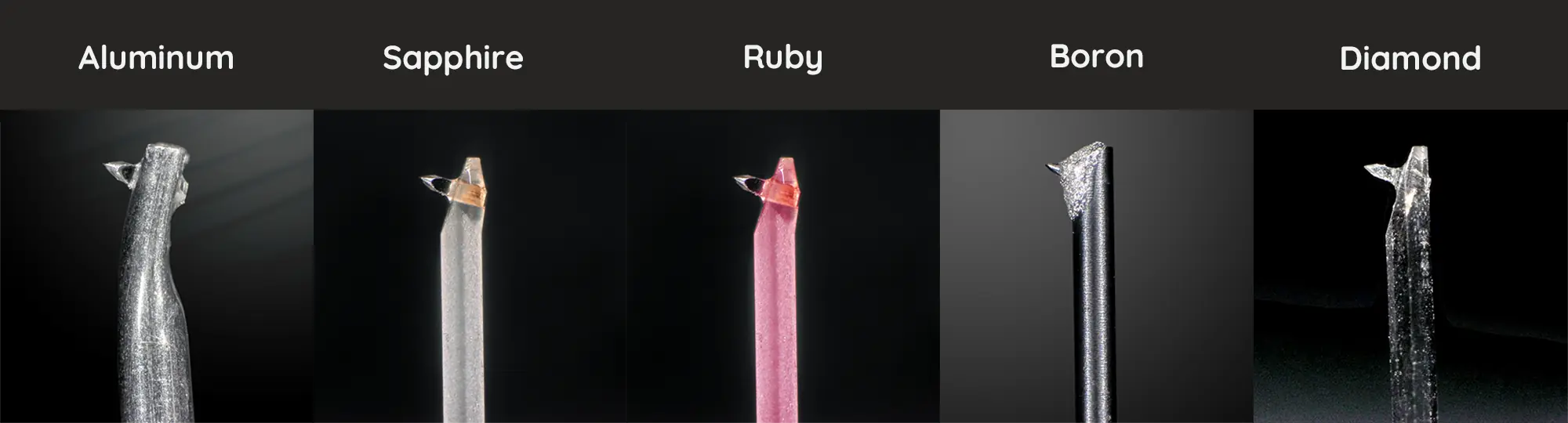
Phono Cartridge Main Cantilever Materials
The cantilever acts as the mechanical bridge between the stylus and the generator system, transmitting the minute groove modulations with precision and speed.
The choice of cantilever material directly influences the cartridge’s:
-
Speed and transient response
-
Resolution and clarity
-
Tonality and musical character
-
Susceptibility to resonance and coloration
Ideally, the cantilever should be as light, rigid, and well-damped as possible, minimizing unwanted resonances and faithfully transmitting stylus motion to the generator.
Here is a comparison of common cantilever materials:
Aluminum
Still widely used in many MM and entry-level MC cartridges. Aluminum is inexpensive and easy to manufacture, offering good basic performance. However, it is relatively soft and can exhibit internal resonance and flexing, which may introduce subtle coloration and limit ultimate detail retrieval.
Sapphire
Extremely rigid and hard, sapphire provides very high resolution and excellent tracking precision. However, it can sometimes lend the sound a slightly cooler or more analytical character, depending on the overall cartridge design.
Ruby
Similar in performance to sapphire, ruby adds a subtle sense of crystalline precision to the sound. It is less commonly used today but remains a beautiful and highly resolving material in the right implementation.
Boron
Boron has become the reference material in many of the best high-end MC designs. It is very stiff, extremely light, and has excellent internal damping properties. This allows for fast transient response, clean articulation, and a natural tonal balance. Boron cantilevers offer an excellent combination of performance and practicality.
Diamond
At the top of the hierarchy, a solid diamond cantilever offers unmatched stiffness, the lowest possible moving mass, and the purest transmission of stylus motion. It can deliver astounding clarity, microdynamic precision, and an uncanny sense of space and transparency. However, it is extremely difficult and expensive to manufacture, and is reserved for the cost-no-object phono cartridges.
Finding the Sweet Spot:
For most Analog Lovers, boron strikes the ideal balance. It combines exceptional rigidity and speed with musicality and ease of integration into a wide range of system designs. This is why it is the material of choice in many of today’s most respected high-performance MC cartridges, including those from Le Son."

