


I know this isn't possible for some speakers, but I found that laying mine horizontally instead of vertically resolved that issue for me. That way all drivers are on the same plane, and with the tweeters on the outside, the soundstage widens considerably. I tried many combinations of height, toe in, and spacing with a vertical orientation but found horizontal at about 38 inches above the floor is best in my room.
Speaker height...should known better
The other day I was listening to my system sitting down on my chair on my computer when all of sudden I had lower my head to glimpse a song on my screen when I realize, wait this sound much better. I have only lowered my head a few inches or 3 and all of sudden the music sounded way better. So much better to a point where it sounded coherent, phase timed and much more dynamic. I thought for a long time I have placed my Triangle BR03 tweeter at ear level. From the perception view from the listening position I would if thought it was at ear level. I was wrong. Currently my ears level is 3 inches above the tweeter(about the top of the cabinet). When I bought the speakers stands a few years ago, I got them new for my other speakers that were smaller. The current height on the stands are 28". I think what need now are at least 31". No wonder my measurements had a gradual roll off of the high end at around 8k at a couple of speakers I had.
Now I am planning on getting higher stands to hear the difference.
- ...
- 48 posts total
It seems like he’s sitting in nearfield. He can tilt it, turn it upside down, do a 360 with it, whatever, doesn’t take away from the fact it is a terrible design.....letting that very mediocre woofer get all the way down to 70, 60 hz and all the way up to 3600hz is just a bad idea....a lot got compromised w.r.t achievable fidelity. He may salvage something by bass managing, preventing that woofer from moving too much, rolling it off around 120hz to a subwoofer pair (needs to be a pair to help prevent localization with a high sub crossover of 120-ish hz)...still a terrible li’l box. On the other hand, a Andrew Jones speaker (suggested as a replacement earlier) with a point source concentric driver, 4 inch mid covering 260 to 1800hz before hand off to the tweeter....A woofer taking over 260hz and under kept that mid driver very stress free.... Especially for near field, it seems like a very good idea, doesn’t it? point source n all (vd not a concern).... I am sure this goofy triangle made all the rounds with the youtube reviewer promo club (the new apparently exciting kid on the block) and made a bunch of guys hop on it.
|
You want limited vertical dispersion, to avoid too early floor and ceiling reflections of wider mid and low frequencies. and tweeters high frequencies are narrow in all dimensions, horizontal and vertical, so you want your tweeters toe-in aimed at your listening position and raised/tilted back to project at seated ear height. tilting back some is advantageous, as it alters the angles of reflection off both the floor and ceiling, and toe-in alters the angle of reflection off the side walls. I put a 2x4 flat above the front two wheels, which raises the front of my speakers 1-1/2", just right for my listening distance horn mouths are usually designed to give even and wider dispertion, limited vertical. My tweeters are Electrovoice T350’s, when mounted vertically, they disperse horizontally https://www.cieri.net/Documenti/Istruzioni/Electrovoice%20-%20Tweeter%20T35,%20T35B,%20T350.pdf what amazes me is how, even though tilted, nothing vibrates off the tops,
https://www.audiogon.com/systems/11516
|
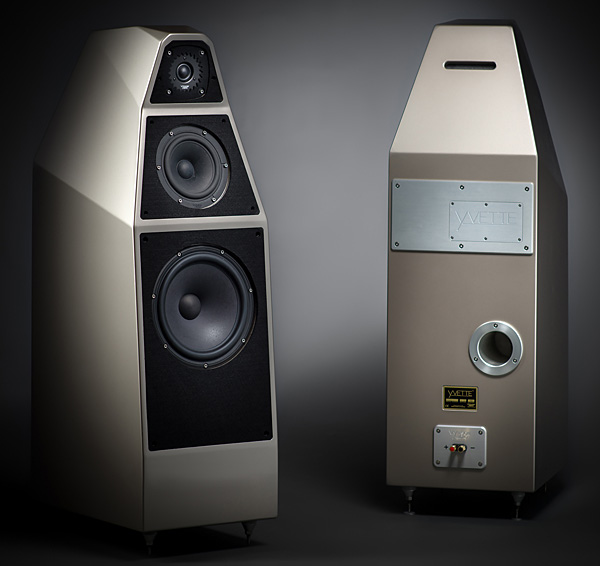
Good idea. Exactly what I wanted to reply with after I read the posted thread. And, its not some temporary hack-fix either, we can show tall speakers where the tweeters and small midrange drivers are in cabinet designs that actually point these units in a downward direction closer to listener ear levels. Some of my low sitting floor standers had the tweeter midrange spacers angled to put tweeters "up" too. For example, rear lower cabinet spikes are adjustable to tilt the Wilson Sabrina Yvette speaker's tweeter downward towards the listener at ear level. Adjust as necessary if its an option to test with a wood block and/or add taller adjustable spikes later vs buying new stands - as another viable option.
|
- 48 posts total