If you expect to hear a difference whatsoever, you will.
And what if us openminded people have zero expectations, yet experience differences?
The end.
Sounds like something that is said from those with expectation bias.

When a power cord could obviously affect SQ
I have been a bit of a non-believer in power cords having magical effects on SQ but I have been discussing with Frank Ng a pair of PP 2A3 amps I am purchasing from TriodeLab. He is supplying a pair of his preferred cables and he points out that the 2A3s’ cathodes are fed directly from the mains transformer.
The amps (UPS willing) arrive tomorrow - this should be quite an experience - it has been quite a game finding great tubes.
Indeed, managing internal noise generated the audio component itself is the primary concern, not preventing external noise from the ether infiltrating the power cable. That a component that is most sensitive to noise can at the same time be the most significant contributor of noise (i.e. self-contaminating) is perhaps ironic, but true. We can bear witness here to those who view a better power cable as some sort of power conditioner, and this is a common misconception. It’s easy to make a power cable that rejects internal high frequency noise (and some cable sellers evidently do). The problem with that is reflecting internal noise back toward the source is going in the wrong direction for the aforementioned reasons. |
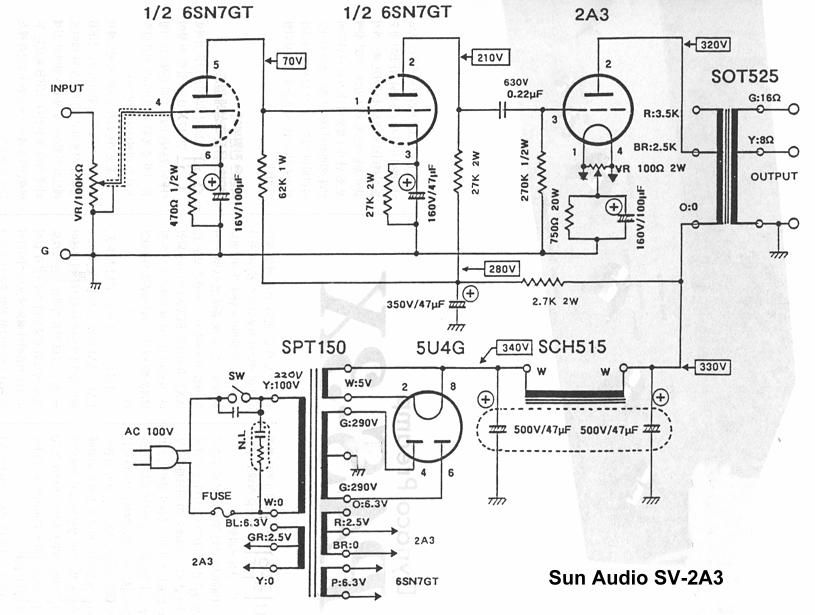
@retiredaudioguy @invalid @erik_squires As you say Erik, live and learn, thanks for that Invalid you are absolutely correct! So the heater and the cathode are one and the same on all 2A3s. I was able to find this schematic for a Sun Valley amp and, realizing that this may not reflect the situation on the amp in question but assuming it also possibly may, it looks like that current to the amp/cathode comes after the rectifier and so is DC. If it were AC wouldn't you expect to hear a hum at whatever frequency the AC cycle is? I still feel that any problems of this sort would need to be thoroughly addressed in the circuit and not left to the choice of a power cord.
|
@bruce19 hum is avoided by the cathode resistor being attached to the mid point of the resistors across the filament. In this circuit there is a trip pot that can be adjusted to minimize any hum or noise. I guess one might add ferrite rings on the filament leads and a small bypass cap (.001 mf) across them to get rid of any RF crap. If you google "filamentary triode" there is a good discussion.
|