Where do classical vinyl records get their rumble from?


Recently converted back to vinyl from silver disks, I am struck by how much rumble seems to be inherent in the new and used vinyl I am buying.

A case in point, is a recent Deutsche Grammophon (DG) recording (487 7484) of Mahler’s Second Symphony made at a live performance at the Sydney Opera House (I was there).  The first set I bought was amongst the dirtiest pressings I have ever had, but the second set was much improved.  However, there is a persistent rumble whether played on my Holbo Mk2 air bearing system or my venerable Garrard 301 (new bearing from Classic Turntable Company).

Mahler typically has huge dynamic range, from muted off-stage performers to hundreds of musicians going hell-for-leather.

The rumble could be partly caused by the venue’s air conditioning system, but I hear similar background on a Telarc recording (Stereo 10051) of Saint Saens Organ Symphony made in Philadelphia.  Telarc even arranged to have local roads shut down for the recording sessions.

Similar efforts were made by DG when recording the organ at Notre Dame in Paris, where recording was done late at night to reduce traffic noise.  My copy includes Dolby Atmos on Pure-Audio Bly-ray (DG 486 1466).

I was beginning to think the rumble was inherent in my tables, but then I played a German Direct Metal Mastered (DMM) set from In-Akustik for Clearaudio’s 40th anniversary (INAK 78051 2LP).  It includes some Telarc tracks.  This set has the quietest background I’ve never heard.  There is virtually no rumble, exonerating my tables.

So apart from the recoding venue’s air conditioning and traffic noise, why do so many classical records seem to have built-in rumble?  Could it be from the mastering lathe?

I am really only thinking about classical recordings where the dynamic range approximates the signal to noise ratio of vinyl, meaning that very low-level signals are musically important, while simultaneously bumping against the noise floor.

richardbrand

@rauliruegas 

Thanks for the link to the Vinyl Engine’s resonance calculations.

I must emphasise that the noises I hear on various records are pretty much the same on both my decks. I am convinced these are artefacts on the records, not in my playback system.

However, just for background information, I tried to measure arm/cartridge resonance for both decks, just using the Tacet test disk.  Only the Holbo showed any resonance, at 6-Hz, and I think that is due to the 55-kg sub-plinth, sitting on sorbothane hemispheres, not the cartridge / arm.  The Garrard sub-plinth does not sit on hemispheres.

At no time do my speakers show excess excursion, which I would expect to be a result of real resonance issues, even with a high compliance Shure V15 type III cartridge.

I am having a few issues when trying to use the Vinyl Engine tabulated data:

  1. DS Audio does not publish compliance specifications
  2. A review of the DS003 claims compliance of 7 × 106cm/dyne at 125-Hz
  3. The Vinyl Engine calculations require compliance measured at a frequency of 10-Hz
  4. I estimate the DS003 (7.7-grams) with bolts weighs about 8-grams
  5. As a tangential tracking arm, the Holbo has different effective masses vertically and horizontally
  6. With Holbo’s 7.5-gram effective vertical mass, the Vinyl Engine table gives resonance of 15-Hz
  7. The Holbo has an actual horizontal mass of 31.6-g, and the table gives resonance of 10-Hz 
  8. The Audio Technical VM540ML has compliance of 6 × 106cm/dyne at 100-Hz
  9. I estimate the VM540ML (6.5-grams) with bolts weighs about 7-grams
  10. The SME Series II improved has 6.5-grams effective mass
  11. With the SME 6.5-gram effective vertical mass, the table gives resonance for the AT cartridge of 17-Hz
  12. The Shure V15 Type III has a dynamic compliance of 22 × 106cm/dyne but no frequency is specified
  13. I estimate the Shure (6.0 grams) and bolts to weigh 6.2-grams
  14. With the SME 6.5-gram effective vertical mass, the table gives resonance for the Shure cartridge of 10-Hz

The biggest unknown for me is the way dynamic compliance varies between 10, 100 and 125-Hz

The rumble issue is a huge topic for me and my VPI. I used to have the Snell Type A V5 speaker set up. This included 2 18 inch woofers. They used to pump like crazy when I played any LP. I talked to VPI who recommended a rumble filter. I hate the idea of putting an audio signal through a device that is doing the opposite of what I'm trying to achieve (highest quality signal unadulterated). I have a rumble filter but I'm unhappy with it. I saw an interesting video where the guy moved the tonearm in and out of range of the platter. His system was energized though the turntable was not rotating nor was there a record on it. As he moved in and out, rumble occurred as soon as he was in close proximity to the rubber mat. He did the same procedure without the mat. NO rumble! My VPI doesn't have the option of removing the mat as you are all aware. I wonder how often static is the culprit. I have a ZERO Stat gun. It's worthless. I have a friend who is a turntable fanatic. He's also an engineer. He's going to take my table this month and do his thing with it. I did reach out to him with this query about rumble. I'll post any updates when he weighs in. Joe

Dear @richardbrand  : Normally Japanese cartridge compliance is measured at 100hz and at 10hz compliance is higher by around 65%.

All those are numbers and the VE calculator works at 10hz. That's all.

.R.

Now, I nevercheck in in my system the Tacet testing record but Iown many others and the best for me is the D2D Ortofon test recording,just splendid. We have to remember here that Ortofon not only manufacture cartridges but even cuting heads that speaks of Ortofon first hand experiences with that subject.


Time to time appears on ebay.


R.

@richardbrand 

For your edification, Paul Miller’s technical evaluation I copied from the Nov 4, 2021 Hi Fi News and Record Review. At the bottom are included are his findings of vertical and horizontal compliance as well as trackability which seems to be very much in line with MCs in general as well as the rest of the performance parameters he lists.

DS Audio DS 003 Cartridge Lab Report

Lab Report

Like the DS-E1 [HFN May ’19] and earlier DS 002 [HFN Jun ’17], the DS 003 may employ a basic crimped alloy cantilever but its line-contact stylus has more in common with the former (Shibata) than the latter (elliptical). Its tracking performance beats both, however, not least because the downforce range has been increased from 1.6-1.8g to 2.0-2.2g in the third-generation DS 003 and Grand Master [HFN Feb ’21] ’optical’ pick-ups. Unlike the DS 002, the DS 003 cleared the maximum 80µm groove pitch (75µm on the right channel) and the most severe +18dB modulation (315Hz lateral cut, re. 11.2μm) at 1.7% THD.

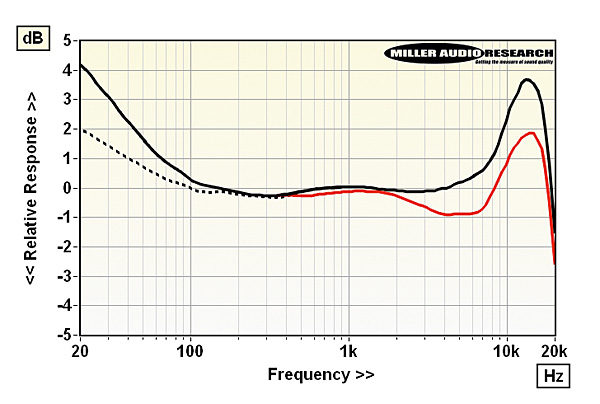
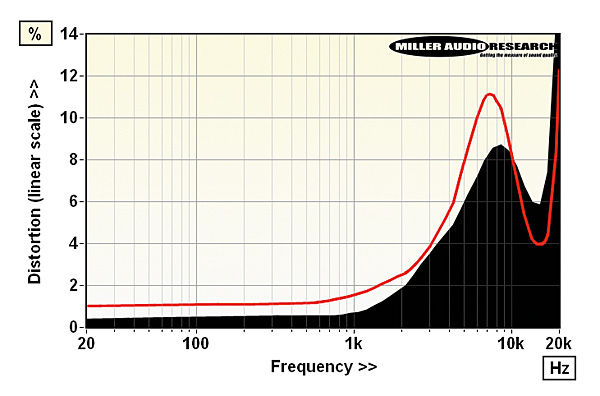
Says Aki, ’In the 2nd generation vibration system, the distortion rate was consistent regardless of the stylus pressure, but in the 3rd generation, the distortion rate decreased when the stylus pressure was increased.’ In practice distortion is slightly lower at 1.5% (DS 003) vs. 1.7% (DS 002; 1kHz/5cm/sec) but trends higher at 0.55-15% (20Hz-20kHz, –8dB re. 5cm/sec) vs. 0.45-10% for the lateral cut [see Graph 2, below]. The latter is as much a function of the DS 003’s improved HF frequency response where the +7dB/12kHz peak from the DS 002 is traded here for a less aggressive +2dB (left)/+3.8dB (right) boost at a higher 14kHz [see Graph 1, below]. The symmetry between lateral [L+R, black traces] and vertical [L–R, red traces] is also excellent while the stereo separation is improved by a huge 10dB (25dB to 35dB) – both clear benefits of the 3rd gen dual optics/shading plate mechanism. Finally, as we’ve seen before, bass output is also boosted, reaching +4dB and +2dB/20Hz via 30Hz and 50Hz settings (first-order roll-off selected). PM

1121ds.lab1


Frequency response curves (–8dB re. 5cm/sec) lateral (L+R, black, 30Hz cut; dashed, 50Hz cut) versus vertical (L–R, red, 30Hz cut)

1121ds.lab2


Lateral (L+R, black infill) and vertical (L–R, red) tracing and generator distortion (2nd-4th harmonics) vs. frequency from 20Hz-20kHz (–8dB re. 5cm/sec)


Generator type/weight Photo-optical / 7.7g
Recommended tracking force 2.0-2.2mN (2.1mN)
Sensitivity/balance (re. 5cm/sec) 940mV / 0.80dB (from Eq unit)
Compliance (vertical/lateral) 15cu / 18cu
Vertical tracking angle 25 degrees
L/R Tracking ability 75μm / 80μm
L/R Distortion (–8dB, 20Hz-20kHz) 1.2–12% / 0.55–15%
L/R Frequency resp. (20Hz-20kHz) +2.0 to –6.0dB / +3.8 to –1.5dB
Stereo separation (1kHz / 20kHz) 35dB / 25dB