@danmar123 +1
Zavfino silver darts use the graphene as the dielectric though, not a "graphite infused" conductor.
What is Zavfino ZGRAPh-LDP GRAPHENE ?
Zavfino is the first audiophile cable OEM to integrate graphene insulation into high-end A/C power cables as a dielectric shield. After more than two years in development with a leading American graphene polymer research company, we’re proud to unveil our new proprietary ZGRAPh-LDPTM conductive shielding/dielectric, first used within our Silver DartTM OCC A/C power cable.
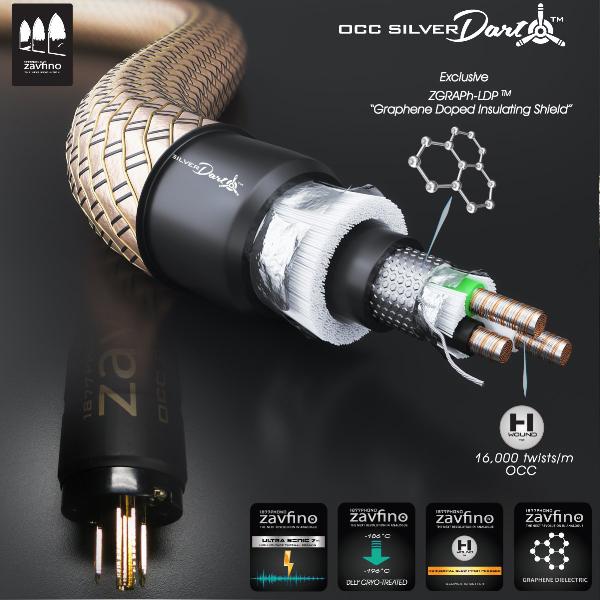
1877Phono or Zavfino are a legit company who do their own manufacturing, and manufacture for other cable companies as well. Tons of information for you objectivists who read more than you listen, and that picture of the construction should/might make you froth at the mouth, but because you will never find any graphs "showing" you they have measurements better than your Belden/Mogami’s, or because you will find something to argue with in their marketing you won’t try them. Shame.
Most importantly, I own 3 of these Silver Dart power cables, and they do make what they are plugged into sound fantastic. Is this the best $1000 US power cord you can buy for the money? No idea. Be warned, they are a real b***ch to work with though, many would not use them for this reason alone.
|
@greg_f
I am based in Europe
Just noticed this at the bottom of their page, and last I heard, like many other North American based audio companies, Zavfino sell more in Europe and Asian markets than North America.

|
My curiosity is peaked. I will try some copper-graphene cables in one of my audio systems. My ears will be the judge not a bunch of theoretical explanations of why it makes no difference. If it does not sound good, the resolution in my systems will shine a flood light on its bad sonics...
|
@jaymark
Make sure to share your findings.
|
Here's an AI overview of graphene as a conductive material. It has other uses as well.
AI Overview
Graphene is one of the most electrically conductive materials known. Its pristine single-layer form exhibits an in-plane conductivity up to \(100 \text{ MS/m}\) (megasiemens per meter). Because its electrons behave as massless relativistic particles, it allows for incredibly high charge carrier mobility. [1, 2, 3]
Key Electrical Metrics
- Pristine Conductivity: Can reach up to \(100 \text{ MS/m}\), which is significantly higher than traditional conductors like copper (\(59 \text{ MS/m}\)).
- Ballistic Transport: Electrons travel through the honeycomb lattice at extremely high speeds without scattering, operating almost like a perfect conductor.
- Carrier Mobility: Exceeds \(200,000 \text{ cm}^2\text{V}^{-1}\text{s}^{-1}\) at room temperature, vastly outperforming conventional semiconductors like silicon.
- Tunability: Its electrical properties can be modified via doping or by applying an external electric field, allowing it to act as an ambipolar semiconductor. [1, 2, 3, 4, 5]
Why Graphene Conducts So Well
Graphene's conductivity results directly from its unique atomic arrangement and electron structure: [1]
- Honeycomb Lattice: It consists of a single layer of carbon atoms arranged in a two-dimensional, interconnected hexagonal lattice.
- Sp² Hybridization: Each carbon atom forms strong bonds with three neighboring atoms, leaving a fourth "extra" electron in a delocalized \(\pi \)-bond.
- Delocalized Electrons: These \(\pi \)-electrons are not tied to a specific atom and can move freely across the entire sheet, similar to the electron clouds found in metals. [1, 2]
Limitations & Current Applications
While a perfect, isolated single layer of graphene is essentially a perfect conductor, practical, macroscopic graphene often performs differently. [1, 2]
- Defects & Grain Boundaries: Bulk graphene materials, when stacked into thick layers (like graphite) or used in commercial flakes, typically face structural defects that scatter electrons and lower conductivity.
- Current Uses: Because it is lightweight, transparent, and ultra-strong, it is primarily used in real-world applications as an additive to enhance energy storage (e.g., in advanced graphene batteries), as well as in flexible touchscreens, solar cells, and electromagnetic shielding. [1, 2, 3, 4, 5]
For deeper dives into advanced research on graphene's electronic properties and real-world testing, check out resources on Wikipedia or explore the experimental mobility reviews detailed in the National Center for Biotechnology Information.
![]() ![]() ![]()
8 sites
-
Can graphene compete with copper in electrical conductivity? - Bosch
Given as appropriate doping enables an in-plane conductivity of 100 MS/m for the graphene flakes with a flake size in the tens of ...
![]()
![]()
Bosch Global
-
Graphene - Wikipedia
Graphene (/ˈɡræfiːn/) is a variety of the element carbon which occurs naturally in small amounts. In graphene, the carbon forms a ...
![]()
![]()
Wikipedia
-
Electronic and Thermal Properties of Graphene and Recent Advances in ...
Graphene is an excellent candidate to replace these materials. Graphene exhibits remarkable electronic and thermal properties and ...
![]()
National Institutes of Health (.gov)
|


