VPI non-Anti Skate Q


I'm sure this Q has been discussed before, but I haven't seen an answer.


I see most brands using Anti Skate as protection from damage to both LP and stylus. VPI is the only brand I see not using it, as they have a different approach that their arms naturally provide anti-skate force.


My Q for VPI Signature 21 using Fatboy Gimbal 10-3D Tonearm: would not using anti-skating be perfectly safe for stylus and LP, same as to other brands who use anti-skate?

Thanks a lot!

mard

... aligning the cantilever might by chance make zenith error worse ...

That's certainly true. But my reason for aligning the cantilever itself is to get a reliable starting point, because every parameter is a compromise and often affected by the others. It's impossible for each to be perfect - after all, there is no "perfect." Audiophiles can't even agree on Baerwald vs. Stevenson vs. Lofrgen null points.

Also, as I noted earlier, if you offset the cantilever on alignment you affect the alignment to the MC cart  coils. 

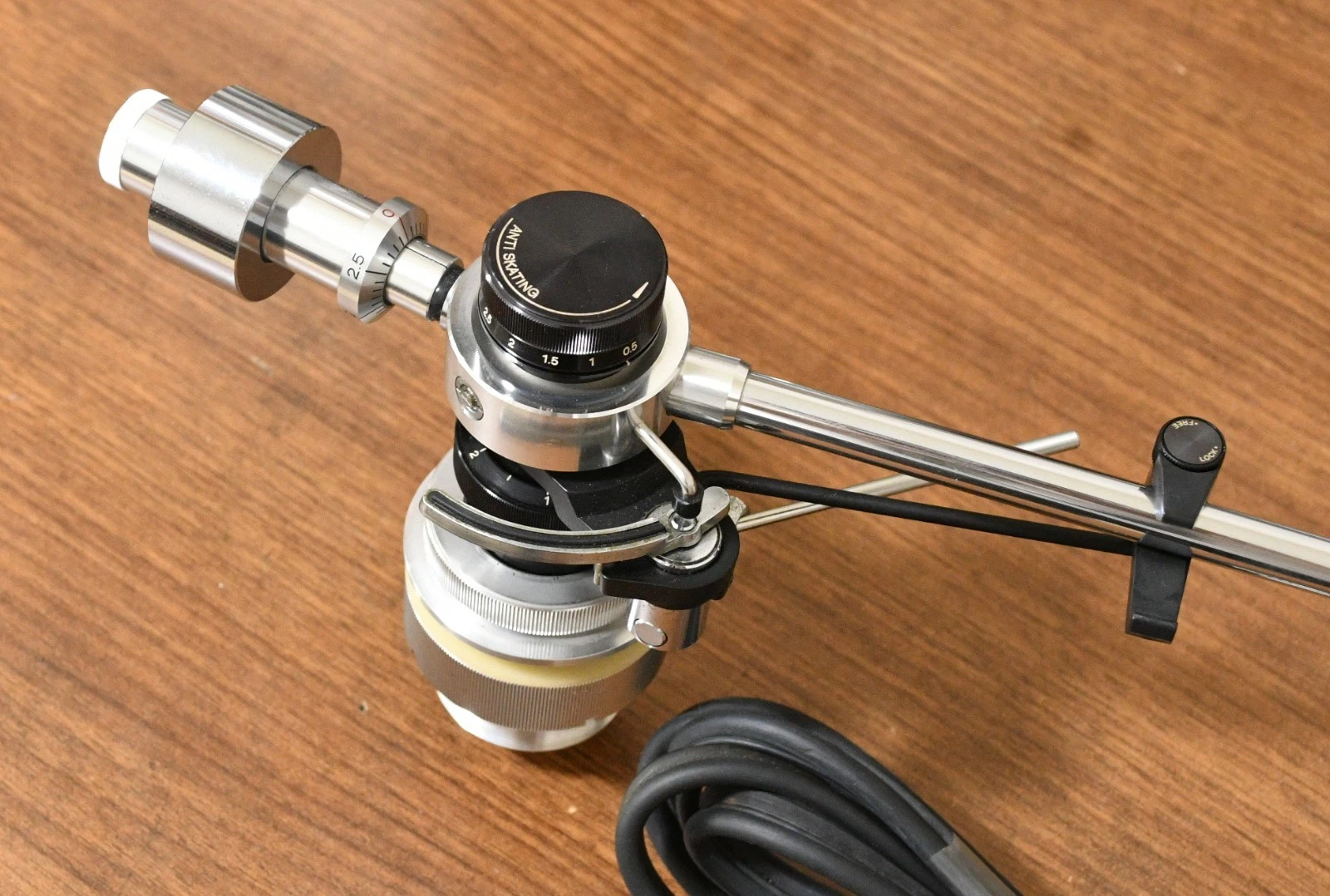
Elliot,You wrote, "I recently found, my Vintage JVC Victor UA-7082 arm: both the tracking weight markings correspond with my digital scale, and the delicate, nearly infinite anti-skate spring also (it’s corresponding marks, who knows what force?) to work quite well. I an bewildered by how an internal spring can be this old and remain accurate."

I am curious how they use a spring to deliver AS, because the force exerted by a spring is proportional to the distance by which the spring is stretched from its resting position, which means that the force would vary linearly as the cartridge traverses the LP surface.  But the internals may be more complex than my simple-minded imagining of what is going on inside. Likewise, magnetic force varies according to an inverse square law, so also ought not to be constant as the cartridge tracks. If one wants a near constant AS force, the good old string and weight has its merits, although even there, there would be slight variation of the magnitude of AS across the surface of an LP, because the angle that the string makes with its outboard guide is changing as the pivot rotates. That changing angle would have an affect on the net magnitude of the AS force. Meantime, the skating force is varying in a manner having nothing to do with springs, magnets, or strings.  Why I wonder what is the "correct setting" for AS.

 

lewm,

You remind me of a lot of us when we were young engineers, all striving for exactness in our solutions for every problem.  As you know, with experience we learn that often the solution involves approaching the final point without ever reaching it.  Why calculus was invented.  I used to preach to my wards the need for practicality and to learn the fine art of satisficing.  When it comes to things vinyl, exactness is particularly elusive.  The subject of the "correct setting" for Anitskate is perhaps Exhibit #1.  One of the things that I have observed using AnalogMagik is that the distortion changes for a given AS setting from the beginning of the band on the test record to the end of that band.  The band is perhaps 1/2" wide and is the innermost band on the side.  So do I set AS for the beginning, the middle, or the end of the test band?  What is the "correct setting" for AS.  I do not know for sure.  What I do, arbitrarily, is pick the setting that yields the lowest overall value for distortion that is repeatable. 
I have a VPI Prime Signature 21. I called VPI and talked to Matt about anti-skate. He was like "whatever you want to do." I finally set the weights to about half way and I look to see if when I lift the tonearm it moves back a little. Otherwise, I've given up. I have done various tests, like listening to see if one speaker sounds louder than the other, using a blank record to see if I can slow down the tone arm from racing toward the center (couldn't), set the weights at full and gave two twists to the wire. I just want to enjoy my music, so I've given up that struggle. I do love the turntable, though. 

@lewm 

You know, for other’s following: it’s the horizontal wheel at the top of the arm.

I am guessing, by the precise feel of the rotation and tiny sensation of clicks, that it’s a very delicate spring (the other immobile end of the spring, due to the increased tension caused by anti-clockwise coiling, pushes out to a speck or a speck more, and, at any degree of tension, maintains that outward push, and is

not effected by rotation or lift of the arm on it's bearings.

however I don’t know that, and I am definitely not taking that mechanism apart.

Anybody know what’s in there, how it works?
