

@richardbrand I never had any luck with these mirror protractors.
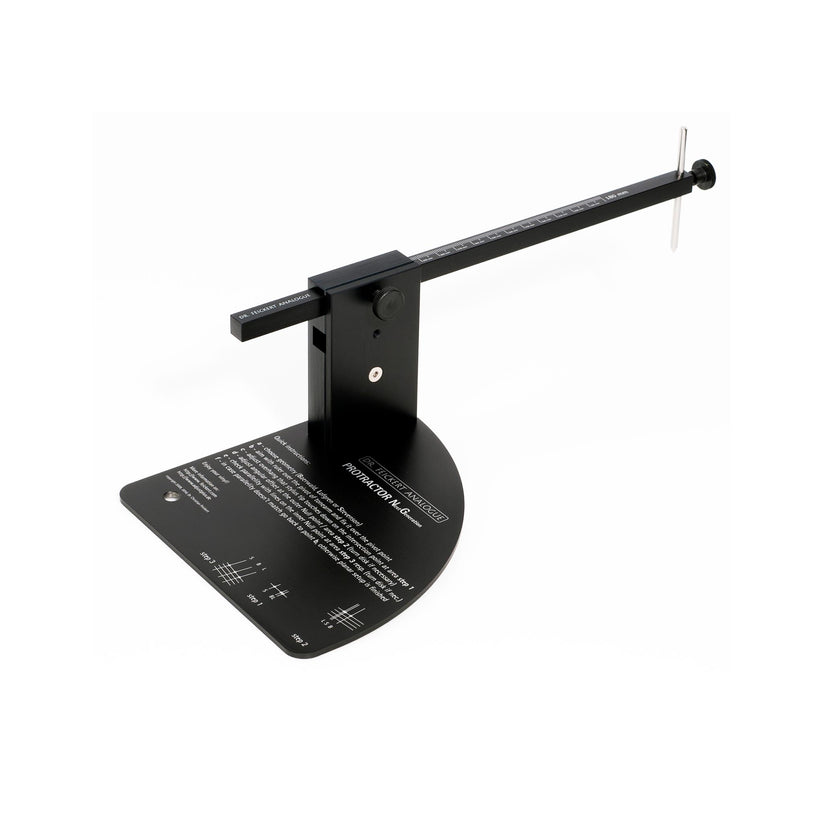
I used the VPI protractor to align the cartridge on my VPI table. On all other tables I used Dr. Feichert cartridge alignment tool. But on the VPI the original protractor works best for me. I would assume Dr. Feichert would work great for the rega. It is pricey though.
Turntable advice / opinion on setup / sound.
Hello all you analog experts. I am seeking some advice, opinions and direction to try, based on my tastes and setup.
I’m not loving my current TT sound but there are variables that could cause this. For reference, my favorite TT I ever owned was the ClearAudio Champion Level 2 (wish I never sold it) because it was warm and had a huge stage.
- I listen to every style of music, smooth jazz to hard metal.
- I have to turn the volume way up to get the get the level I like which at times has hiss and a tiny bit of hum. Compared to digital sources which have none of these issues.
- I find this setup to lack huge stage and warmth.
My current system is:
- Rega Planar 8 w/ Alpheta 2 MC cart.
- Cambridge Audio -> Alva Duo Phono Pre amp
- Mark Levinson -> No 585 Amp.
- Martin Logan 15a Renaissance -> 8FT apart/ 3ft off the front wall and 3 FT from each side wall. I sit 9FT away from the speakers.
The turntables I am considering are:
1) Musical Fidelity -> M8XTT
What cart would you use?
2) Michell Audio -> Gyro SE Turntable
3) Clear Audio Champion Level 2
Thank you all in advance for any guidance and opinions you can offer.
- ...
- 185 posts total
Oh, I know smug. I said he LOOKED Smug, then, after the video I said he is NOT Smug. I lived in Brooklyn, Manhattan; worked in NYC for around 20 years, after that, my own home based business in NJ, train to clients in NYC for around 20 years. Still have Studio Apt in Manhattan, but should sell it, hardly ever there. Aside from strangers, I designed Corporate Office Space, thus I interacted with the executives, and every employee of my clients; engineers, other project consultants; contractors; NYC building dept creatures. One line I’ll never forget was Bill, the wizened contractor building a 12 story Bank’s Headquarters Building in Tyson’s Corner, Va. After meeting with the Health Inspector to get write offs for the big kitchen serving the cafeteria and executive dining, he says "Elliott, I thought I had met EVERY KIND of ahole, but I was wrong".
/////////////////////////// I use a weight, I have used a clamp, I heard no advantage, and his explanation needs practice. As for the 4mm up for 1 degree of VTA: so what, you get close to parallel with the main height PITA set screw(s), then you refine height with the ’on the fly’ easy adjuster.. Substantially different cartridge height: reset the main height close, then refine with the ’on the fly’ easy adjuster. Rega: add some shims, just need to know they exist. ///////////////////////////////////// Hudson setup kit. Your memories are daft, eyesight shot, that's their logo around the spindle
Note the range of null point settings for my 9" arm and my 12-1/2" arm, There are not enough lines on the Friggin Feickert to handle between 60 or 73 inner, or between 103 or 120 outer.
Faustuss finally got us the answers for Rega RB880: overhang 15 (14.5 exact if you can see/set 1/2 a mm); inner 57; outer 117. I doubt there are enough lines on the Feickert for that either. I prefer the maker’s recommendations rather than the 3 well known standards. |
Actually, I woke up this morning thinking: I wonder if I could put a linear tracking arm on my setup? I have LT in my office, had it with the Technics SL-J33 (gave it to my son). I'm a believer in LT, admire the tech, know it's 'better', but I don't hear a difference. I've gotten great sound out of all my pivoted arms. |
Not all LT tonearms are created equal. But certainly the Holbo cum LT tonearm is not the only game in town. RB, you wrote, "Seems to me the arguments for under-hung are quite, well, under-done! Try this. Imagine a reference line between the tonearm pivot and the stylus. The primary friction force is along the reference line. But any time the groove at the stylus point is not completely aligned with the reference line, there will also be a sideways component, the skating force. This is regardless of the shape of the arm and any offset of the cartridge. It is also regardless of the amount of under- or over-hang. It is simply because the friction force always has a sideways component, except when the groove and reference line are in perfect alignment." Are you actually trying to explain the origin of the skating force to me? If so, here are some of the issues you leave out that make for a big difference between underhung and overhung pivoted tonearms as regards the skating force. These may not concern you of course, as you are using an LT tonearm. First, in order to achieve a TAE or HTA or LTA error of only 2 degrees (assuming no zenith error), an overhung pivoted tonearm must have its headshell offset at an angle with respect to a straight line through the cantilever and pivot point (the same angle you refer to above). This offset angle ranges from about 20 to 22 degrees for a 9 or 10 inch arm, less for a longer arm. That automatically results in an angular error equal to headshell offset and causes a skating force that is always directed inward. Any TAE along the way simply adds to the headshell offset angle as a further cause of inward skating force. For an underhung tonearm with zero headshell offset, it is true that TAE at the extremes of travel (innermost or outermost grooves, if you set up the underhung tonearm such that its single null point occurs close to the midpoint of the grooved surface, or actually about one-third of the distance from the innermost grooves) can develop about 10 degrees of TAE (less for longer than 9 inches), all of which does contribute to a skating force, BUT the skating force of an underhung pivoted tonearm changes direction before vs after the stylus reaches the single null point. So there is no constant unidirectional skating force. Moreover, for a large fraction of the playable surface of an LP, before and after the stylus reaches the null point, the angular error is small and only very gradually reaches maxima. Because the force vector changes direction around the null point, it is not feasible to apply an AS device on an underhung tonearm. But this may be a good thing. An AS device applies a force near the pivot to counteract skating that occurs at the stylus tip. This puts a constant tension on the cantilever. That tension cannot be a good thing, as the real job of the cantilever is to transmit the unadulterated undulations of the groove wall from stylus to the transducing mechanism in the cartridge body. So it’s a question of which is worse for the job of the cartridge, high TAE as it affects the profile of the stylus in the groove in an underhung tonearm or high unidirectlonal skating force as in an overhung tonearm. In my opinion, one has to listen to both. |
You'd just have to find some space and some dollars! But I agree with @lewm - there are many designs of linear tracking tonearms and they will likely be as different from each other as pivoting tonearms are, and maybe more so! Some cost more than a complete Holbo system and none, in my opinion, is better than the Holbo's tonearm from a design and engineering viewpoint. |
- 185 posts total