

Microscope for cartridge inspection


I'm looking for a microscope for cartridge inspection (hence the tittle) and came across this in my search.

https://andonstar.com/product/ad246s-m-ad249s-m-3-lenses-10-7-in-lcd-hdmi-digital-microscope/

Does anyone have any experience with this scope or this company?

audiorusty

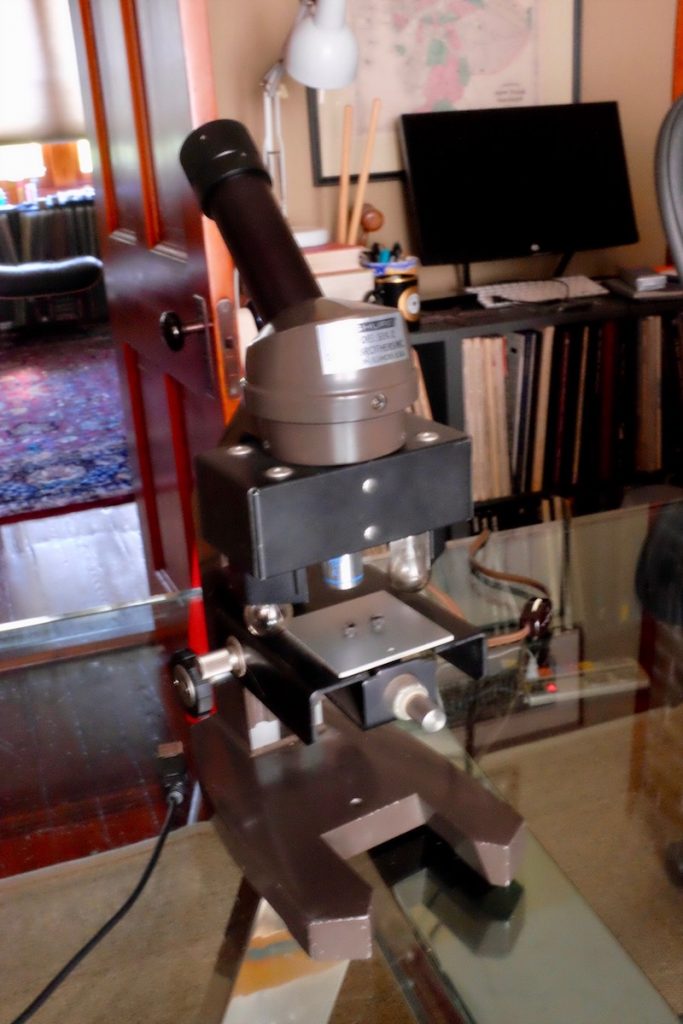
I found one of the Shure stylus microscopes on E-Bay several years ago in very good condition. It is mainly intended to examine removable styli, but you can use it to look at a moving coil cartridge stylus (non-removable). That said, I'm not qualified to evaluate stylus wear, so I rely on either the manufacturer or a third party. 
the instructions above about uploading a pic to the web, then inserting it in a post

I just came across this, it sums up "too many words"

"Like so many photographic techniques, it's much simpler and quicker in the doing than it is in describing it."

Elliot, Re the photo you posted above. If that is "1000X" according to your USB camera, it operates very differently from my optical Olympus lab microscope, because according to the Olympus owners manual, the max magnification I can achieve is 140X (achieved by zooming on a 10X image, rather than by altering the lenses).  At that max setting on my microscope, I am very much closer to the stylus tip than what I can see in your published photo. I can see a lot more detail.  I guess this speaks to the difference between digital and optical ways of calculating magnification.  You’ve spurred me to acquire the capacity to make photos for comparison. But for sure you do not need 1000X magnification if using an optical microscope.

Be careful of microscopes (and telescopes) that claim magnifications using area. Honestly reported, magnification means that a linear dimension appears to occupy a wider segment of your field of view, so that for, say 10x, a 1mm object appears to be 10mm (technically, the angle subtended by a linear dimension of the object studied is in a 10:1 ratio magnified to unmagnified). But some will report that such an object now occupies 100x the area in your field of view. That would be fine if they were open about what they mean by magnification, but that is rare.

Doggie, You have an Olympus too, correct? How do the images you see compare to the photo E posted? Or maybe you are inferring that E's USB microscope uses the "area" criterion to define "magnification" that you describe.