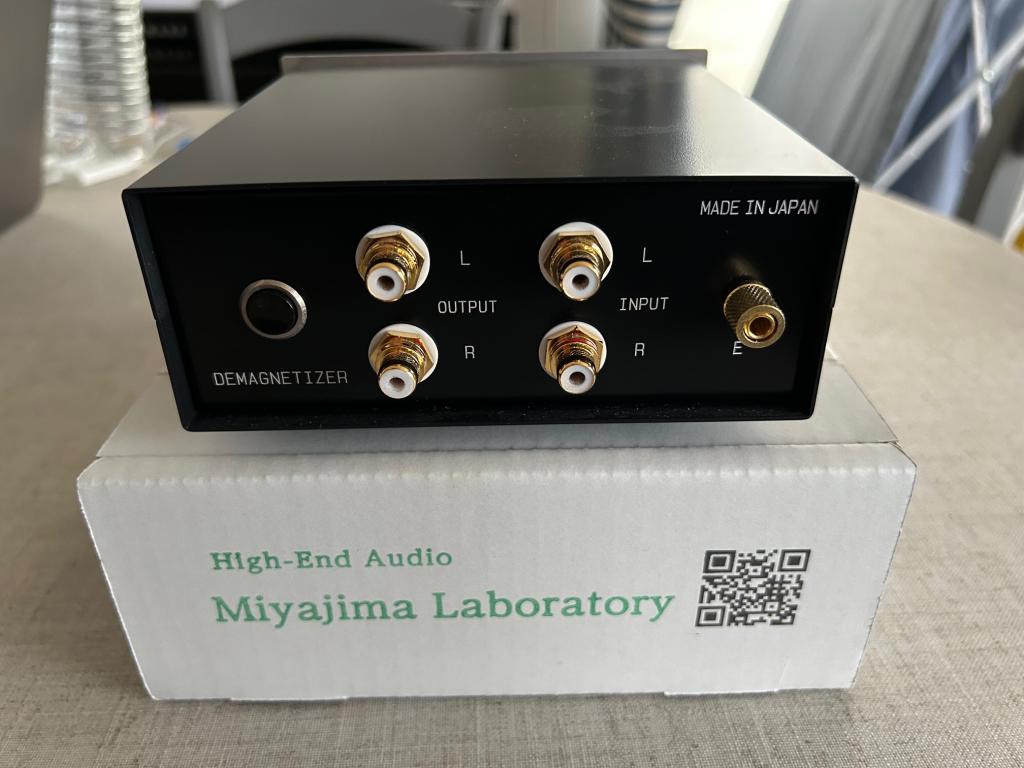
Recommandation for 1:6 1:8 SUT under $5K?


I’m looking for some advice on a step-up transformer that pairs well with my Audio Research LS28SE, PH9, and Hana Umami Blue cartridge. I currently have both the Denon AU-S1 and AU-340. The AU-S1 sounds absolutely beautiful—very transparent and open—but at 1:13 the gain is too high, and I’m getting some clipping, especially on dynamic peaks. Even with the AU-340 at 1:10, I can still hear a bit of overload. I’ve tried playing with loading and parallel resistors, but the issue really comes down to gain. I think something in the 1:6 to 1:8 range would be perfect, enough to keep the clarity and tone I’m getting from the AU-S1 but with better headroom. My budget is around $5k, and I’m open to any recommendations for a high-quality SUT?

arazmj

intactaudio, lewm, everyone

I encourage watching the video, it’s a unique solution, and he discusses noise among other things

https://www.youtube.com/watch?v=IBnxwatJu_w

I bet big bucks the interviewer is faking his understanding, but no matter, Robert just keeps on yapping

Instead of talking about "X factor", which is probably confusing to a neophyte, why not just impart the simple equation that governs the input impedance seen by the cartridge? Which is that the input impedance seen by the cartridge will be the value of the input impedance of the phono stage divided by the square of the turns ratio of the SUT, which is given in the notation, "1:10", for example.  So, for a standard 47K ohm MM input resistance/impedance and if using a 1:10 SUT, the impedance seen by the cartridge will be 470 ohms (10-squared = 100; 47K divided by 100 = 470). In such a set up, the input impedance can never be higher than 470 ohms, unless one were to place resistors in series with the signal, which is a no-no.  So what these SUTs that allow some adjustment of the load resistance must do is to insert a resistor in parallel with the 47K ohm load, which results in a lower input impedance, every time. (The parallel sum resistance of any two resistors is always less than the value of the largest of the two resistors.)