
Modding the PS Audio Directstream DAC MK1 and MK2


The PS Audio Directstream MK1 was first released in 2014 making them 12 years old. They were a great sounding and highly sought after DAC back in the day as they extracted the digital signal like no other.. They converted all incoming digital signals to 10x DSD, did all necessary SDM and other necessary calculations using a FPGA chip. (Field Programmable Gate Array). Then sent the DSD signal at 22.5792Mhz through eight (8) special opamps, (four 4 for each channel) then sent through an audio transformer out to the balanced line outputs. Ted Smith designed this architecture for PS Audio. As in all manufacturing, the final product had many cost cutting and saving design changes made to the original design to make it affordable and profitable for market.

Recently most all of these shortcomings have been rectified and upgraded to make this unit one of the best sounding DACs available today.

APS Audio Transformers provides many parts and provides upgrades and also complete units. Their best available unit, The Limited Edition Signature Series PLUS clearly redefines the state of the art at a price that is not inexpensive but represents extraordinary value.

What sets the Directstream MK1 apart is its remarkable capacity for improvement through targeted modifications. In fact, after such refinements, the Directstream MK1 is widely regarded as one of the best-sounding DACs available for under the $15,000 price range. Its ability to reproduce music with exceptional clarity, naturalness, and dynamic expression has yet to be surpassed by competitors within this tier. This makes it a coveted choice for audiophiles who seek the ultimate audio experience without venturing into ultra-high-end price segments.
In summary, while the Directstream MK1 starts as a solid performer, its true brilliance emerges through thoughtful modifications. This journey from a very good DAC designed by renowned Ted Smith to an exceptional one illustrates how expertly executed upgrades can elevate audio equipment to new heights, offering an unrivaled listening experience for discerning music lovers.


I would like to continue discussing these modifications to help the audiophile community. If you have thoughts or recommendations, please share them here. Thank you!

jk_richards

Here is whats upgraded from the original PS Audio Directstream DAC in the APS Limited Edition Signature Series + DAC.
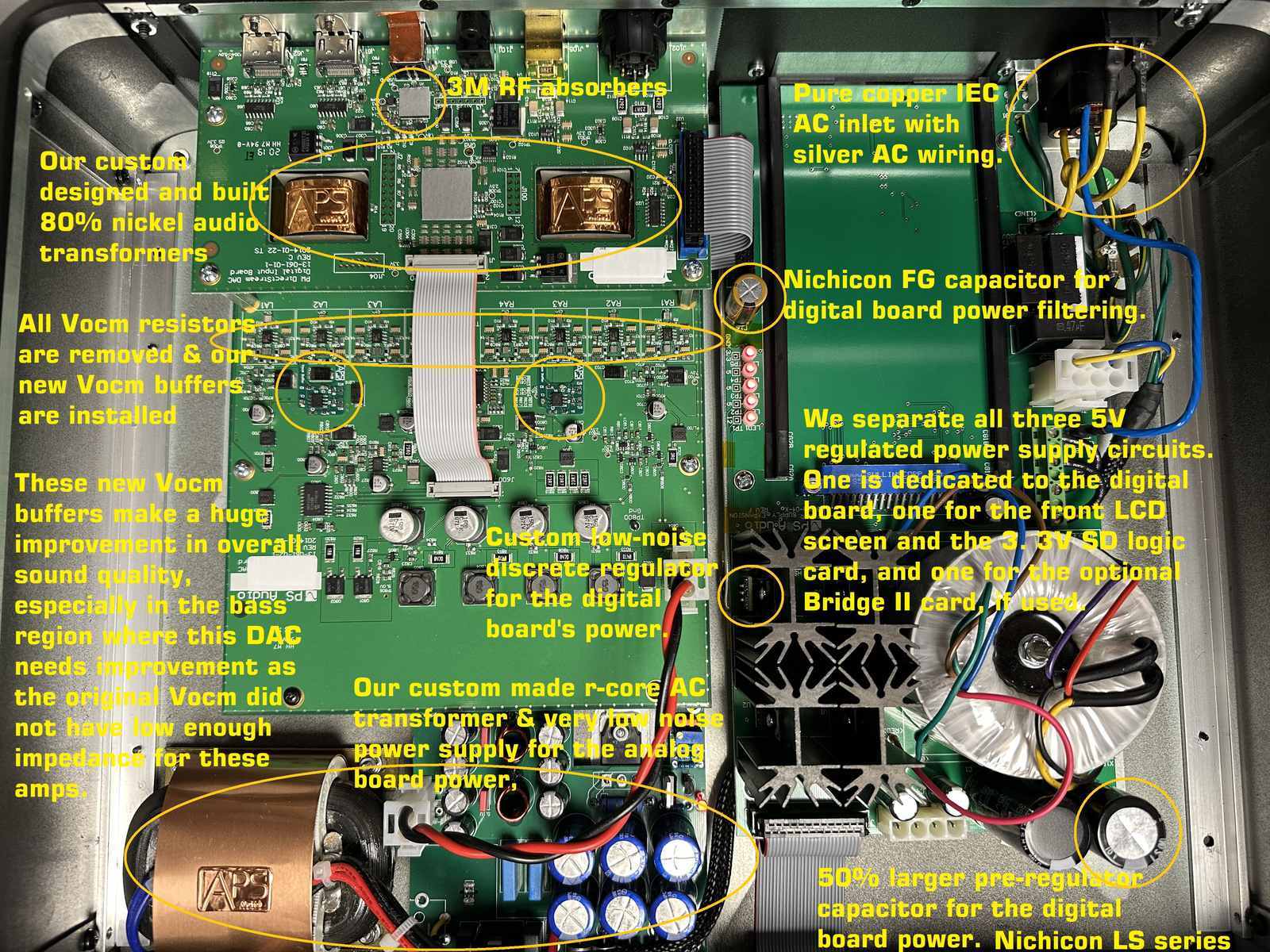

A little history of the Directstream DAC.

Paul McGowan, the leading man at PS Audio of Denver/Colorado, was introduced to Ted Smith via a mutual friend, the SACD maven Gus Skinas. Ted is a software developer with an immense track record. He is also a hardcore music lover who has been tinkering with SACD and its underlying DSD format for many years after encountering his first SACD disc.
His then Sony SACD player became the first victim of Ted’s experiments and was altered substantially versus its DAC’s original layout. This became the start of a serious project to design and build the best DSD DAC possible. Cost was no object nor was the size of the thing under development. From the beginning Ted was clear that the use of a commercial DAC chip wouldn’t be an option. What he had in mind was not possible with a single chip nor a massively paralleled array as what many manufacturers revert to. Being a software guy, he decided to do all conversions to proper DSD in software. This meant a field-programmable gate array or FPGA.

Now he coded a true 1-bit converter into his gate array. Initially Ted meant to use the DAC only for DSD and process that specialized signal for the very best analog equivalent on the other end of the DAC. But whilst working on the project he discovered a software solution that would accept any kind of digital input signal. In true software guy fashion, he merely looks at what enters his FPGA. By sampling that signal at very high speed, the resultant pattern determines the signal’s format. This welcomes PCM at all going rates just as it does DSD. In fact it converts all PCM to DSD in the process. 

An additional advantage of this process is that the incoming clock signal is discarded. Once the signal type is recognized, there’s upsampling to 30 bits at 10 x the standard DSD rate or 28.224MHz to push noise deeply into the ultrasonic sphere. Before the signal hits the low-pass filter to convert to analog, it gets downsampled to DSD128 at 5.6448MHz. Ted’s gate array has plenty of bit headroom to dedicate 20 bits to just volume control over 100 x 0.5dB steps across 120dB. In total his DSP environment can process 50 bits of data density.

According to Ted Smith, "DSD is whatever bitstream gives you after running through a low-pass filter". A bitstream with a high signal results in a lot of high pulses, a bitstream with a low signal results in a lot of low pulses. Pulses represent energy, hence high pulses mean high energy. Sounds simple, doesn’t it? In PCM encoding the bits give you a number. That number has to be translated to an electric level at very high precision. The electric level is set by little resistors inside the DAC chip. This inherently limits precision and the power may fluctuate a little.


Yes...

I had a Successful bone marrow transplant. Since there is no cure for my caner, this should give me some more years to have fun in this hobby.yes