

I recently bought a DP-3000NE and the tonearm is quite excellent. I don't know if Denon markets the arm separately, but if so I commend it to your attention without reservation.
Selecting Between Vintage Denon and Microseiki Tonearms
As I work through the build on the DP 80 project, I know the Dynavector DV505 tonearm is going on that table. That means I need one more arm for the DP75 on the DK110 plinth. My preference it to keep the factory armboard and retain as much as the vintage vibe as I can. This will be my casual table.
While I cannot confirm it, I imagine this armboard is drilled for a Denon tonearm. I have roughed the measurements out, but cannot know for certain until the Dynavector is pulled off it.
In doing a bit of research, there are a handful of Denon arms that are worth exploring. But it looks like the Microseiki arms use the same mounting distance, and I could use one of them.
For Denon I have the choices of DA 307, 309, and 401. I will use medium compliance moving coil cartridges.
With Microseiki I have seen the MA505, 705, 303, and 707 available at various price points.
Anyone have insights on which arms are preferable? I am afraid i do not have a lot of experience with these generations of vintage arms. .
- ...
- 10 posts total
I found some info about Bill’s new Denon tonearm: from this review https://hometheaterhifi.com/reviews/vinyl/turntables/denon-dp-3000ne-turntable-review/ "The DP-3000NE tonearm is actually not a new design. It is a modern recreation of Denon’s DA-309, which was first seen in 1977 – a tonearm from back in the day. Denon says we should refer to the new arm as the DA-309 as well, but there were a couple of updates made to the unipivot design. The material and finish of the headshell, the color of the anti-skating box, and a revised magnet fixing structure. Most noticeable to the user is the presence of the tonearm lift, which required a redesign of the tonearm base. That new base also adds the ability to adjust VTA. The overall geometry is little changed from the original DA-309, using an S-shaped, extruded aluminum tonearm for an effective length of 9.6 inches. Regarding Dynamic Damping – the goal is to prevent stray vibrations going from the table to the cartridge, via the arm, or in the other direction, dampen any vibrations that do get started in the arm as the needle does its business in the groove. All of this is in keeping with the overall design goals consistent with Denon’s history of making turntables for use in professional broadcasting. As I look at my 4000 records, I sometimes feel that I must be a bit of a nut. I do find comfort in the extensive design expertise that goes into all of the equipment, however. It proves that I’m not the only nut. Denon’s deep thought regarding tonearm design is a good example. There is some serious engineering here. But I wondered, of all of the Denon tonearms from back in the day, why was the DA-309 chosen as the starting point? The answer was three-fold: 1) It fits the need for a wide compliance range, the ability to support the fecundity of cartridges that we all enjoy in these modern times. 2) The DA-309, due to its vibration dampening, has very low resonance in the key range of 20Hz to 1kHz. And 3) The aesthetics, “classic modern”. Anti-skate is magnetic and is a snap to adjust. The procedure is combined with setting the stylus pressure – pull out a small plunger at the base of the arm mount, adjust stylus pressure, turn the knob at the end of the anti- skate plunger to match the stylus pressure weight, push the plunger in. The VTA adjustment is via a separate knob on the base, as mentioned. The manual queuing lever is undamped, but I learned to control cartridge descent in just a few tries. At the other end of the groove, the arm will not lift automatically. As far as I can see, there is no room to install an aftermarket lifter such as the Little Fwend or Audio Technica AT600SR, which I own but can’t fit to either of my tables." |
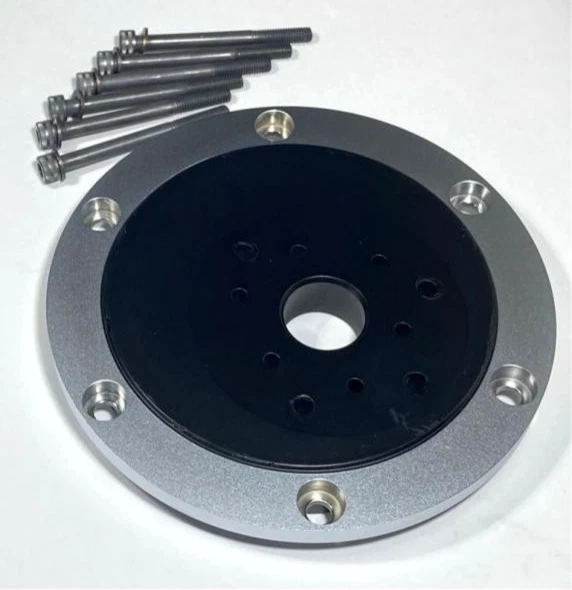
My friend might put one of these on his Lenco rehab project I’m not sure, but, like others, I imagine the black disc rotates, allowing arms of slight differences of s/post lengths to be used, and it would conceal many existing holes. It adds some height below the arm, so the total minimum/maximum height must be considered
|

- 10 posts total