EFFECTIVE DRIVE MASS
Some time ago, I developed my own personal audio term — something I had never encountered in books, engineering papers, or audiophile discussions, yet something that perfectly describes an important phenomenon I constantly run into when matching amplifiers and loudspeakers.
I call it Effective Drive Mass.
To be clear from the beginning: this is not an official engineering specification or a scientifically measurable parameter. It is simply a practical concept — my own attempt to describe the combination of factors that determines how easy or difficult it is for an amplifier to truly energize and control a loudspeaker system.
The idea first came to me many years ago, during the early stage of my audiophile journey, after an experience that completely overturned my understanding of speaker sensitivity and amplifier matching.
Back in 2015, I was already helping people assemble systems built around vintage Japanese audio equipment and considered myself a fairly experienced audiophile. At home, I owned a large vintage system based on the legendary Japanese Diatone DS-5000 speakers, driven by a vinyl front end created by a well-known analog specialist and a Nakamichi 1000 cassette deck.

The amplification was bi-amped: a solid-state Sansui controlled the bass section, while a KT66 tube integrated amplifier handled the mids and highs. Everything was connected through an Audio Research SP-3 preamplifier — a legendary component that was ranked among the top vintage components by Tone Publications and placed first in The Absolute Sound’s list of “12 Most Significant Preamps of All Time.”
And honestly, the system sounded wonderful to me at the time.
I could not even imagine then that years later I would improve its sound by another twelve or fifteen “levels” — by levels, I mean specific moments when, after some “tweak”, the system suddenly crossed into a noticeably higher class of realism and musicality.
Here is how that system looked several years later: in addition to various systems in the showroom, I had the "personal toy" in my workshop, where I’ve been restoring vintage speakers and experimenting - a vintage multi-amping system with two active crossovers.
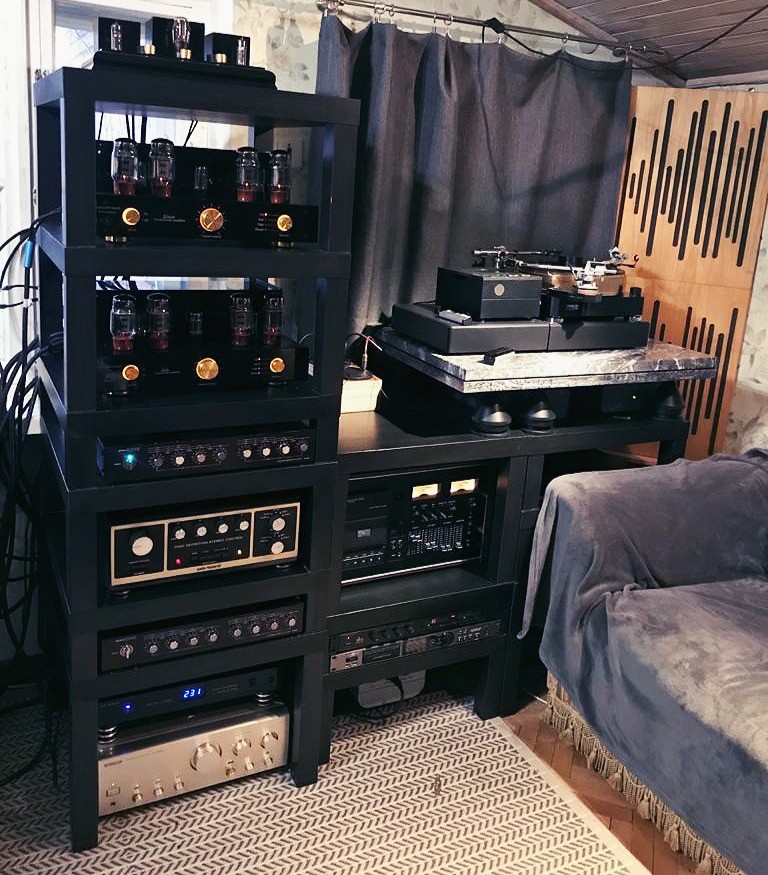
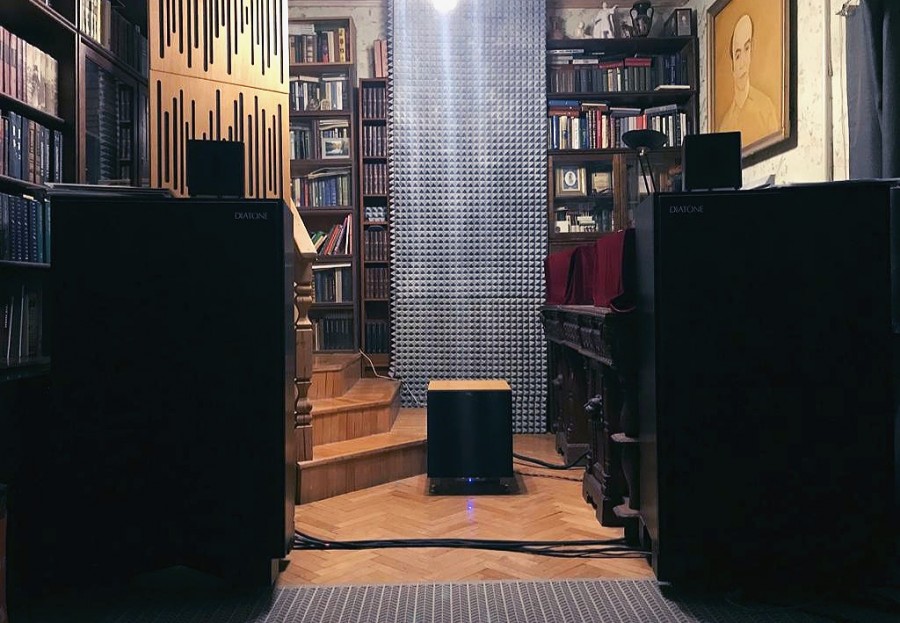
That multiamp setup was built in 2020, and in 2015, I still had the bi-amping system. Furthermore, I had used the KT66 integrated amplifier along with those Diatones, and the speakers still played quite convincingly. Yes, the bass was somewhat soft and not particularly articulate, but there was never any feeling that the amplifier was incapable of driving the speakers. The system still had energy, body, and musical involvement.
At that stage of my experience, most of my audio world revolved around vintage equipment: Sansui, Audio Research, Technics, Diatone, and similar components. It was an incredibly useful period for understanding sound, but I had not yet truly encountered serious modern high-end systems.
Then one day, a customer contacted me. He had brought a pair of Blumenhofer Gioia horn speakers from Germany and asked me to help him find the right amplification. He had already experimented with various setups, but nothing completely satisfied him. One amplifier sounded too cold and analytical; another, too aggressive; another, lacking emotional involvement. At the time, the system was running with a Boulder power amplifier and an EAR 912 preamplifier.

I should say immediately: even in that configuration, the sound of the Blumenhofers completely shocked me.
Up until then, I had heard many good vintage systems, loved my own setup, attended High End exhibitions where most systems left me cold but a few impressed me deeply, and generally believed I understood the approximate limits of what audio reproduction could achieve.
Then suddenly those limits disappeared.
It no longer felt like a sound system. The room itself disappeared. There was only this enormous, almost cosmic vocal floating in vast black space far beyond the walls, with instruments existing independently inside a huge three-dimensional environment.
Yes, one could argue that the presentation sounded slightly cold and sterile — and that is precisely why the owner wanted to move away from the Boulder amplification. With horn speakers, Boulder created an extremely precise, hyper-analytical sound that lacked emotional warmth.
Trying not to show how shocked I was by what I had heard — and being absolutely confident in my own audiophile expertise — I said:
“Don’t worry. This is easy. We’ll make the system sing.”
My logic seemed perfectly reasonable.
If my Diatones, with roughly 93 dB sensitivity, could play convincingly even with a relatively modest KT66 tube amplifier, then surely Blumenhofers, rated at 96 dB sensitivity, should absolutely fly with the same tubes. Furthermore, the Gioias allowed bi-amping. At that time, I was fascinated by the possibilities of bi-amping and considered it almost a secret audiophile weapon. I was certain I was about to amaze the owner of the Blumenhofers.
So, I brought two tube integrated amplifiers: a push-pull KT66 amplifier and a single-ended KT120 amplifier.
The plan sounded beautiful in my head: the more powerful and controlled KT120 would handle the bass section, while the KT66 would drive the upper horn section, giving us speed, dynamics, scale, tonal richness, and beautiful tube texture.
We connected everything. Turned on the music. And the owner of the Blumenhofers was indeed amazed. The speakers suddenly sounded like old public-address radio horns. The music became flat, lifeless, compressed, and weak. No dynamics. No authority. No sense of scale or energy. Even at high volume, the system sounded as though the amplifiers could barely move the drivers.
I remember sitting there completely confused.
How could speakers rated at 96 dB sensitivity perform so much worse with these amplifiers than my 93 dB Diatones?
A week later, I eventually found a completely different solution for those speakers — an amplifier built around the legendary GU48 tube, also known as the 833A.

I will definitely return to the 833A in a future article because, in my opinion, it is one of the greatest audio tubes ever created.
But the important thing is this:
That experience forced me to ask myself a question.
What factor exists in amplifier and speaker matching beyond sensitivity and impedance?
Why did the Diatone DS-5000 perform reasonably similarly with both the GU48 and the KT66/KT120 combinations, while the far more sensitive Blumenhofer barely functioned with the KT amplifiers yet became magnificent with the GU48?
That was when I began disassembling speakers, studying crossover networks, examining driver structures, magnets, and internal construction. Comparing vintage Japanese systems with modern high-end designs, I started noticing a pattern.
If you open vintage Japanese speakers like Diatone or Technics, you often find relatively small magnets, lightweight voice coils, thinner wire, and fairly simple crossover networks with a modest number of components.
Even if the cabinet itself is physically large, the system’s internal mechanical and electrical “mass” is surprisingly low.
Now open a serious modern high-end loudspeaker like a Blumenhofer.
Everything changes.
Huge magnets.
Massive motor structures.
Large voice coils.
Heavy crossover assemblies filled with giant Mundorf components.
Thick internal wiring.
Enormous stored mechanical and electrical energy.
And at some point, I finally understood something very important:
High sensitivity does not necessarily mean easy drivability.
Because an amplifier does not simply produce volume. It controls and energizes an entire mechanical and electrical system. And that is exactly what I now call Effective Drive Mass. In other words, the total mechanical and electrical “weight” that an amplifier must energize and control.
This includes:
- crossover complexity,
- voice coil mass,
- internal wiring,
- mechanical inertia,
- stored energy,
- and the overall physical complexity of the system.
If we use a car analogy, the amplifier is the engine, and the loudspeaker is the vehicle’s total mass. Accelerating a small, lightweight car is dramatically easier than moving a heavy luxury sedan. Imagine a Maybach powered by the engine from a Toyota Prius, and you immediately understand why the Blumenhofer Gioias barely played with those tube integrated amplifiers.
The same analogy also explains why the Diatone DS-5000 sounded relatively similar with both the KT amplifiers and the massive GU48 amplifier. The Effective Drive Mass of the Diatone was simply far lower. Put a Maybach engine into a Prius, and the car will not suddenly become a Formula 1 machine. The rest of the engineering limitations remain.
Since then, I have become less cautious about judging speakers purely by sensitivity numbers. And far more attentive to Effective Drive Mass.
That is exactly why, recently, when someone on an audio forum asked whether a Mastersound Compact 845 integrated amplifier could properly drive Harbeth SHL5XD speakers with their relatively modest 87 dB sensitivity, I looked at the situation very differently than I would have eleven years ago.
If I were still the version of myself from 2015, I probably would have answered:
“No, 87 dB is probably too low for a tube amplifier.”
But today I think differently.
In my opinion, the Harbeth SHL5XD has a relatively low Effective Drive Mass. The drivers are not excessively heavy. The voice coils are comparatively modest. Mechanical inertia is moderate. The crossover structure is relatively simple.
At the same time, the 845 tube possesses extraordinary linearity and dynamic headroom. An 845 tube typically operates at plate voltages of 900–1200 volts, while a KT120 usually operates at 400–700 volts. That enormous voltage reserve allows the amplifier to reproduce transient peaks with less compression and with a much greater sense of ease and scale.
Because of its natural linearity, a properly designed 845 amplifier produces:
- more textured bass,
- smoother and less grainy treble,
- deeper soundstage layering,
- and a more relaxed yet authoritative presentation.
But perhaps most importantly, the 845 controls loudspeakers exceptionally well because it maintains signal structure under complex dynamic loads more effortlessly than many smaller tubes. In simple terms, the 845 transmits musical energy with less sensation of mechanical strain.
And that is why, despite the relatively low sensitivity of the Harbeth SHL5XD, a good 845 amplifier — especially something like a Mastersound — can not only drive them successfully, but actually produce an exceptionally beautiful, alive, rich, and emotionally convincing sound. Definitely more emotionally engaging than many solid-state amplifiers within a similar price range.
So what practical value does the idea of Effective Drive Mass offer to music lovers? It reminds us that amplifier matching cannot be reduced to sensitivity numbers alone. Sometimes a 96 dB speaker turns out to be an incredibly demanding load. And sometimes an 86–87 dB speaker with low Effective Drive Mass suddenly comes alive beautifully with a well-designed medium-powered tube amplifier.
That is why I believe Effective Drive Mass can sometimes tell us far more about real-world amplifier matching than the dry numbers printed in specification sheets.
In the next article, I will talk about my close encounter with the legendary 833A — also known as the GU48 — the extraordinary tube that ultimately transformed the Blumenhofer Gioia system discussed in this story.




