Another Practical Use for YouTube


I came across an older version of Tin Pan Alley that I had made and for those who say YouTube is BS, it certainly serves well here to hear differences.

Especially listen on the first cut at at ~2:13 and you can hear a very pronounced resonance. Is it the room, or the speakers, or just the speakers exciting the room?

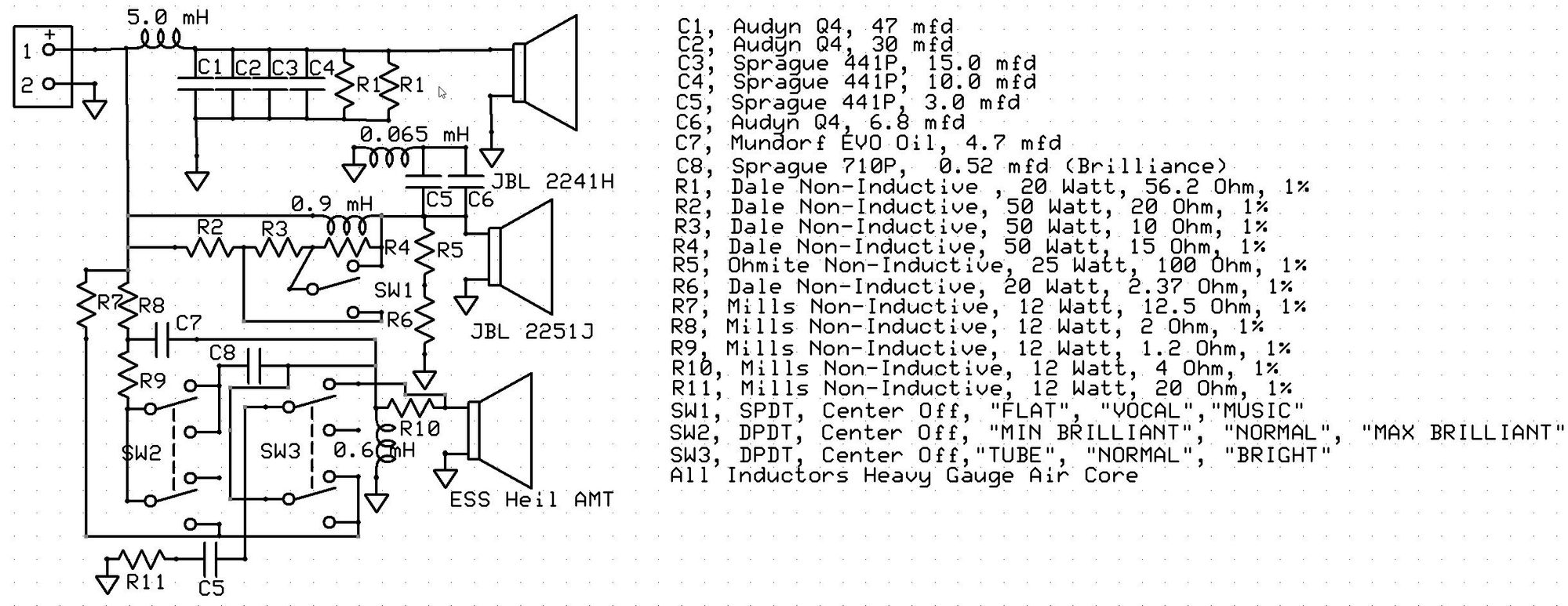
Doesn't matter because I was able to address it through minor changes to the crossovers and you will note that this resonance is pretty much gone and everything is more articulate in the second take.  Thus, I know that my modifications are going in the right direction.

Of course this also demonstrates another of my theories.  Changing the value of a $3 resistor can have a greater impact on the sound than changing out cables/components.

If you can't hear the difference, you need to change something.

https://youtu.be/cO8T6R2WhTE

https://youtu.be/P1R2dKRDFUk

toddalin

The first one is way too bright/sharp, edgy.

Second one is improved.  Adding a stronger resistor acts the same as a treble control. 

You can't make this kind of a dramatic, obvious change using cables. Not close.

God job! Well worth the effort.

In this case it is the addition of R5 and R6.  This decreases the "16" ohms of the 2251 to ~13.8 ohms, changing its high end roll-off.

Similarly R1s work with the 2241 to reduce its "Q".

Rather than trying to make the room match the venue, I recognize that's not going to happen in such a large area and I try to bring the venue into the room by tuning the speakers for the room, in the room.  This has taken years of listening with countless crossover changes.  Goes a whole lot further than fancy gizmos and do-hickies.


Oh, BTW, these were built using Craigs List and eBay parts at a cost of less than $1,500 for the pair of speakers.  I could spent 50 times that for a pair of high end speakers, and they still wouldn't be tuned for the room.

Great job! Usually people don’t tune speakers for a particular room. It’s done the other way around: they change the room acoustic to fit the speaker. Not many of us have the knowledge to do what you did. Commercially, it would be impractical since the speaker manufacturer doesn’t know our room and would need to adjust the speakers ever time we move. More power to you. Have you thought of measuring the frequency response with something like REW?

I have a Behringer DEQ 2496 61-band RTA that I use in tuning, but the ear gets the final say.  Seems like the mic is never exactly where my ears are and I primarily use it for near field measurements when determining what a part change is doing at the speaker.

Also, because the Behringer's pink noise is mono, you can only do one channel at a time.  Anyone who tries to use a mono pink noise signal on both channels simultaneously is engaged in an exercise in futility. 

Let me get this straight.  You recorded two different times with the speakers in two different locations, and you think your $3 resistor is responsible for the change in sound?