
I needed some more bass in my system. I had quality bass but not enough.
I thought I needed more power or to add a subwoofer.
I got a new preamp so I could run a particular NOS tube.
Now I’ve got it. Plenty.
I didn’t need more power, or a subwoofer.

All About That Bass
Many strive for “great bass” by using a subwoofer or speakers that extend to 30 Hz or below. But even though a system may go low, it is often accompanied by an uneven frequency response and ringing. While it may sound nice or even great as the walls shake and the neighbors complain, over time it can be fatiguing and does not sound good. The problem is not because of the system but rather because of two types of low frequency reflections in the listening space.
The first is the Speaker Boundary Interference Response (SBIR), which can be thought of as comb filtering bass-style. It happens when the direct sound from the speaker hits the ear and is immediately followed by the reflected sound from a surface (wall, floor, ceiling) that is in relatively close proximity to the speaker. As these two signals arrive at the ear slightly out of phase, they interfere with each other constructively and destructively, which leads to peaks and nulls, respectively. The solution is to move the speakers to a spot that is far enough from/close enough to the front and side walls. One typically must live with the reflections off the ceiling and floor.
The other influence is standing waves. These are created by frequencies that have wavelengths that are multiples of a room’s dimensions. For example, at 10 ft that frequency is 113 Hz and at 33 ft it is 43 Hz. Unlike other sound waves which lose energy (amplitude) rapidly as they bounce around the room, when two waves of a modal frequency bounce off opposing walls, they oscillate back and forth (resonate) for a while before dissipating. Also, unlike other frequencies, these waves do not move throughout the room but just bounce back and forth in the same place, hence the term, standing wave. This creates areas of increased and decreased wave amplitude, again leading to peaks and nulls. Because they are stationary, one deals with this by moving the listening position to a place with the fewest standing waves.
Simply stated, the key to good bass is to reduce peaks and nulls, whether due to SBIR or standing waves, and the first step should be to optimize placement of the speakers and listening position. GIK Acoustics, Arqen, Acoustic Frontiers and others can provide guidance for this.
The next step may be to absorb the waves in the first place rather than allowing them to reflect. Unfortunately, most commercially available bass traps do little below 100 Hz, as indicated by their websites’ associated data and graphs. While they may trap the mid to upper bass, they ignore the rest, which is where many of the worst problems arise. To have an impact in this lowest range of frequencies with their very long wavelengths, passive traps must be huge with a thickness measured in feet. Alternatively, range-limited traps such as Helmholtz resonators are helpful, but require multiples if there are multiple problem frequencies.
Another approach is to add a subwoofer. Many already do this to extend the low end, but it has the additional benefit of contributing to a flatter response as it adds more waves to interact with those of the main speakers. This introduces more constructive and destructive interference, but the new interactions now contribute to an attenuation of peaks and nulls through cancellation. Just as with the mains, position the sub to create the best response.
While one sub is good, more is better because there are more opportunities for wave interactions and concomitant cancellation. Two is considered the minimum but more than four is regarded as diminishing returns. While some may balk at the impact on the living space, they may be less obtrusive than large passive absorbers or numerous range-limited bass traps.
A further attribute of multiple subs is that they enhance imaging and provide a more immersive experience with a soundstage that is clearer and better defined. They can also provide greater flexibility in speaker placement by allowing for an emphasis on imaging rather than bass.
One can also employ active bass traps. My understanding is that past attempts accomplished this by detecting an offending waveform with a microphone and then used a driver to immediately send an inverse wave out into the room to cancel or at least attenuate it through destructive interference. While somewhat effective, they were challenging to position and could do more harm than good as they spewed additional frequencies into the room.
The latest effort by PSI Audio operates differently. Its Active Velocity Acoustic Absorber (AVAA) also uses a microphone and drivers but adds DSP technology. It analyzes decay times and sound pressure levels and specifically targets standing waves. Instead of sending an inverse wave out when it detects a spurious signal, the driver instead moves in with the wave and “absorbs” it (acoustic impedance). Unlike subwoofers, it does not add any additional waves to the room but instead removes them, essentially acting as a hole in the wall for lower frequencies (15 Hz to 160 Hz). Just like passive absorbers, it is an acoustic sink, not a generator. It does next to nothing to extend frequency response, nor does it have a huge impact on peaks and nulls.
The preceding is what may be called “natural” solutions because there is no before-the-speaker signal processing, such as with a parametric equalizer or digital signal processor. While I do not use DSP, it has found its place in many systems. I leave it to others to share its virtues and limitations.
Finally, if you have the resources, the ultimate solution is to get a room large enough to reduce reflection interference in the first place. It will require a lot of money to buy the space and even more for speakers capable of pressurizing it. Four subs and a few bass absorbers are a bargain by comparison.
In summary, consider placing your speakers and listening position in the places that give the smoothest, deepest and cleanest bass, recognizing that imaging and other factors may also influence your decision. Further gains can be had with passive bass traps, subwoofers and active bass traps. The most bang for your buck will be accomplished by adding subwoofers.
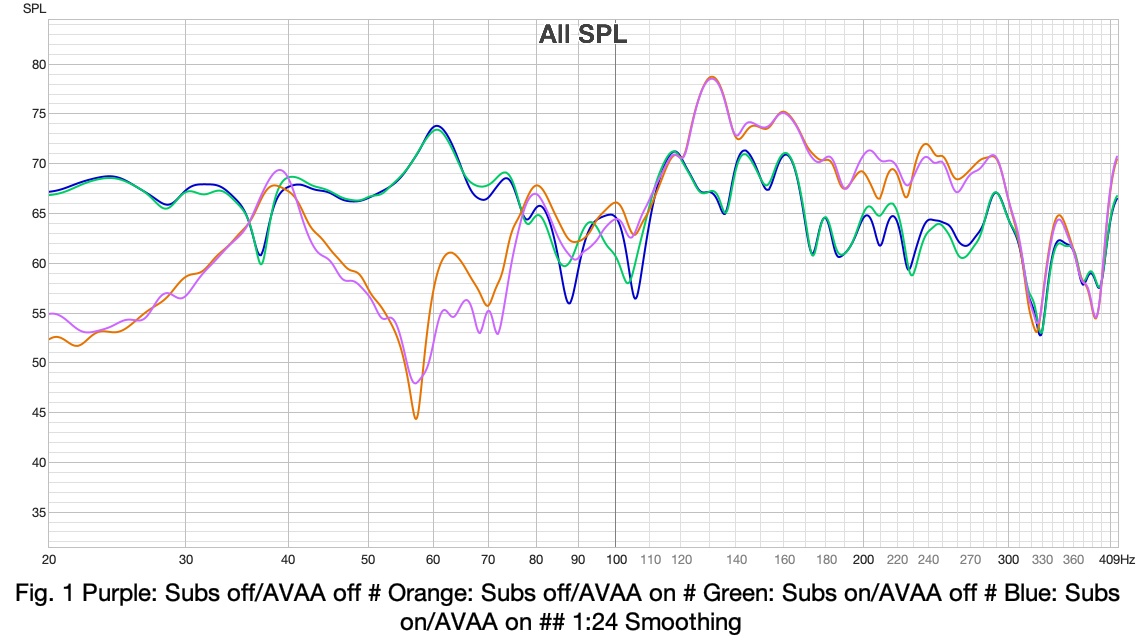
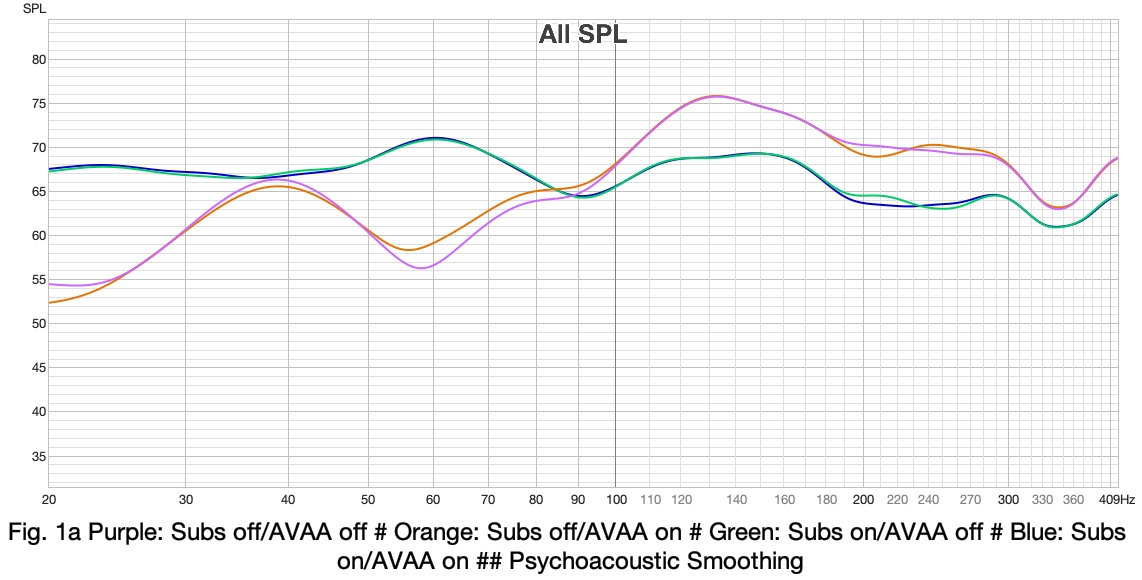
To support these suggestions, the following figures demonstrate what multiple subs and AVAAs do for the signal. Figure 1 has the X axis as frequency and the Y axis as amplitude (loudness) and shows a room with passive bass traps only, with/without four subwoofers and with/without active bass traps. The greatest impact on peaks and nulls is with the subs, active traps not so much. Figure 1a uses the same data but better represents what we actually hear.
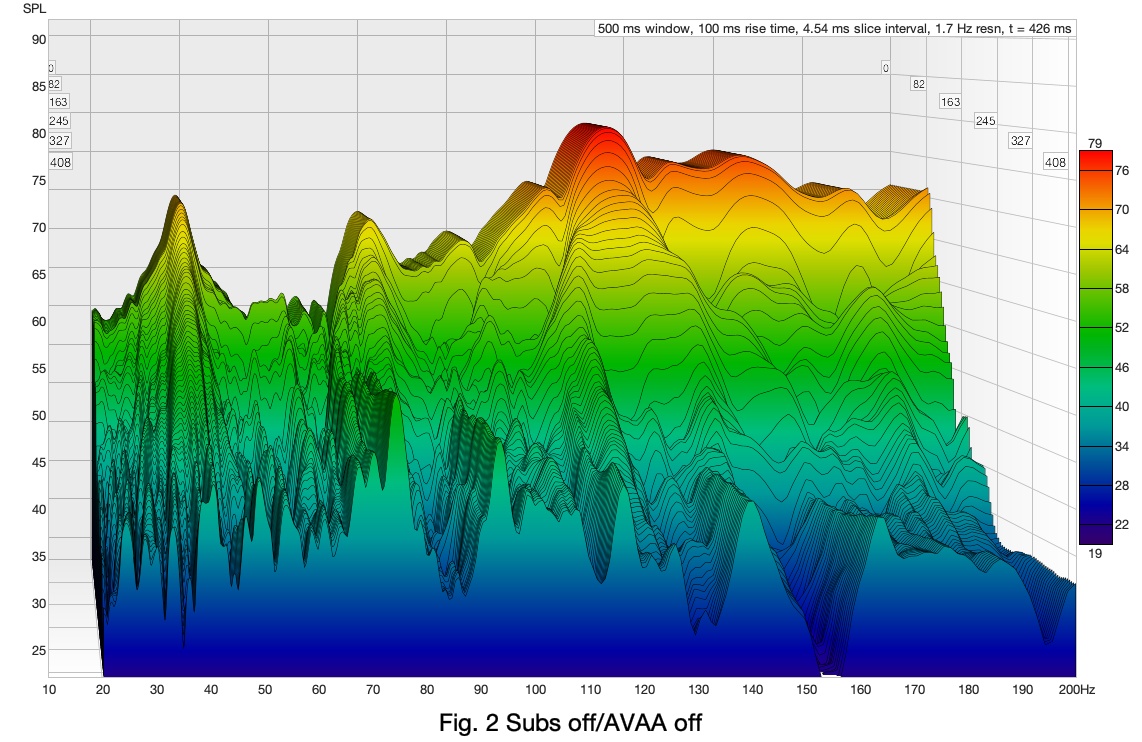
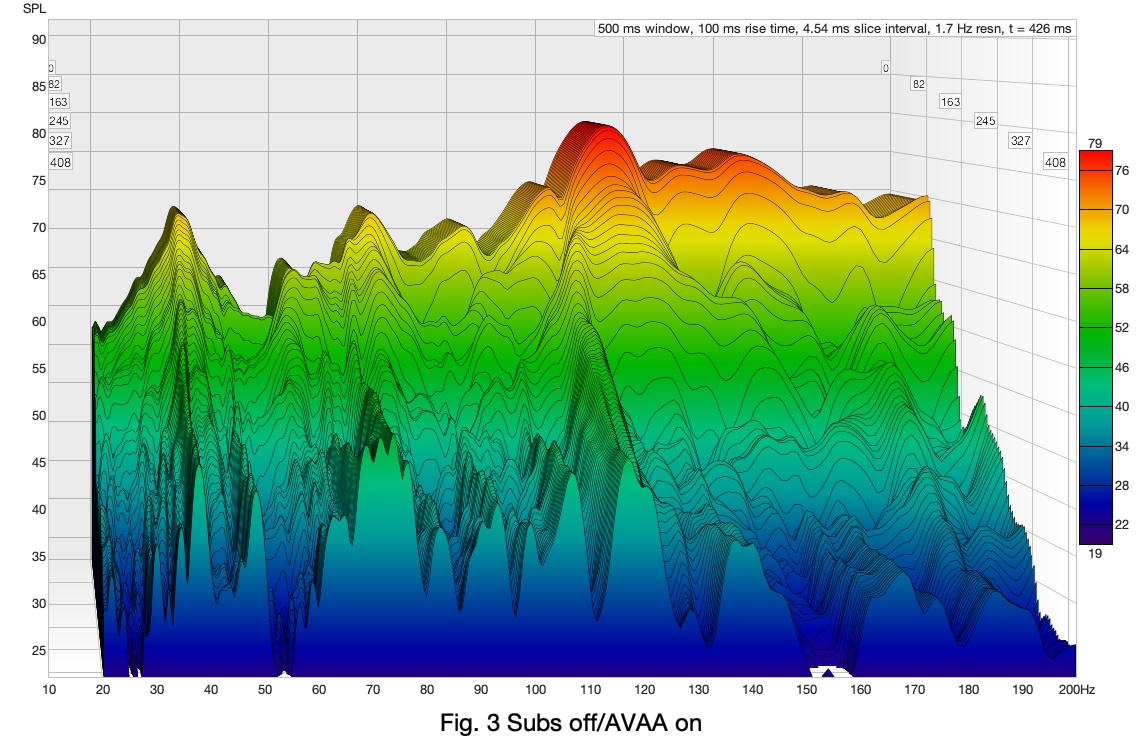
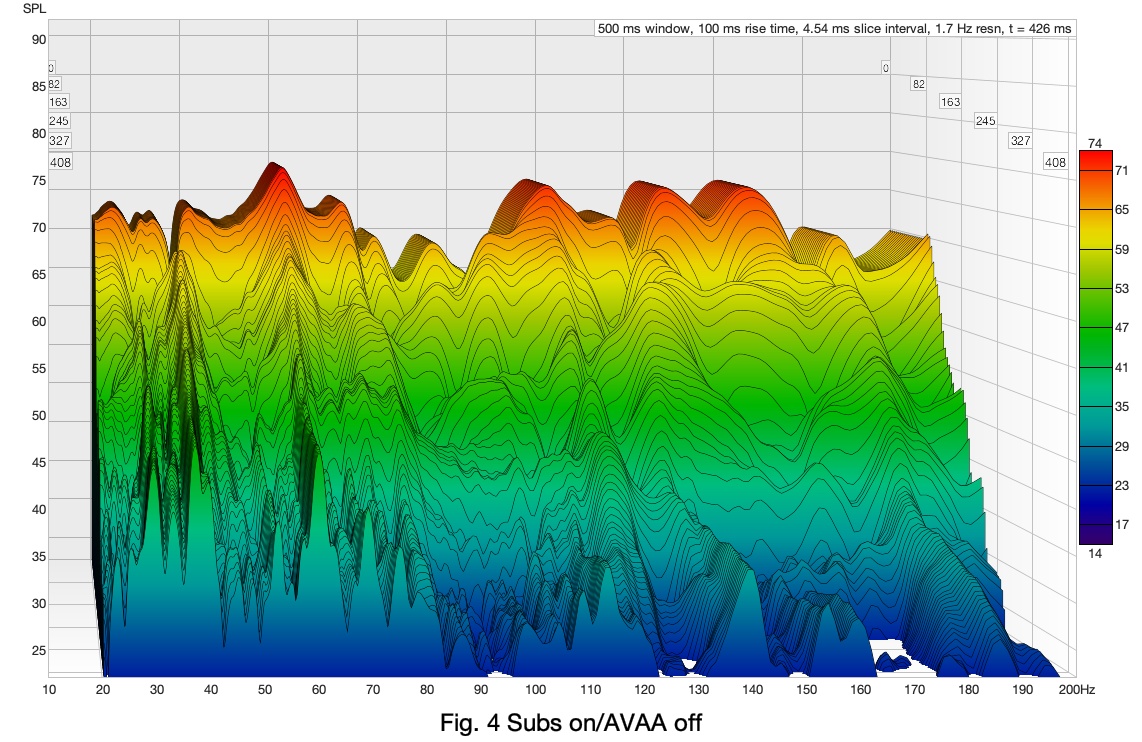
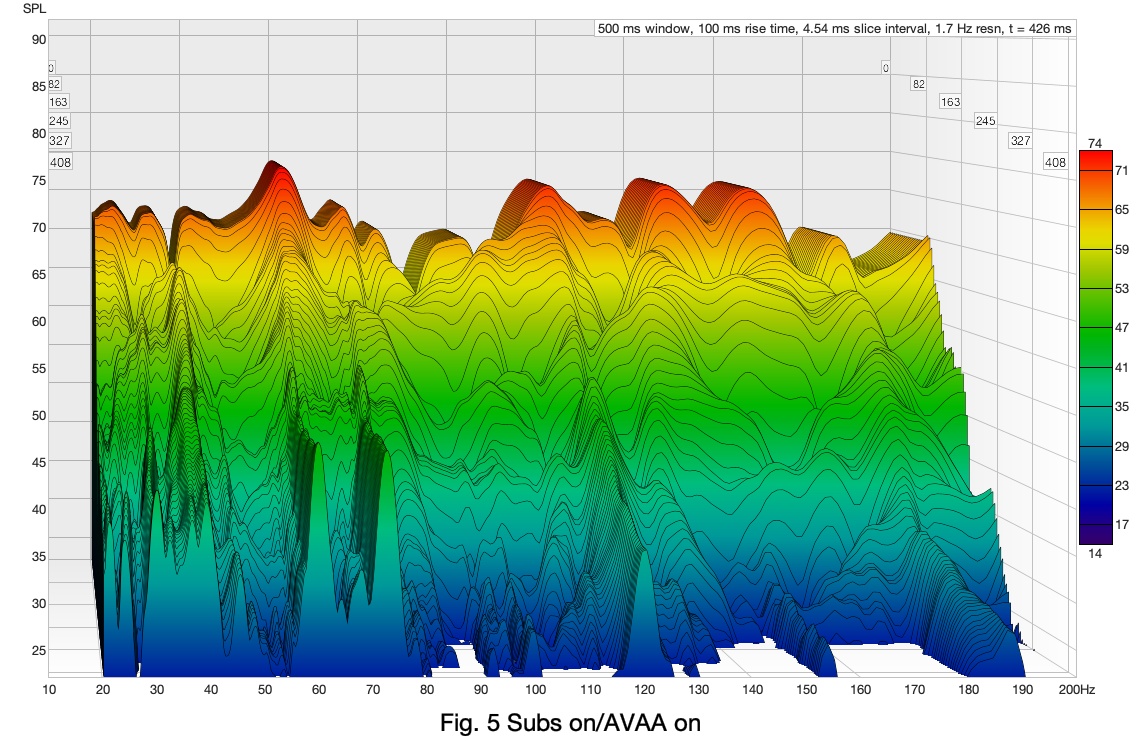
The waterfall graphs in Figures 2-5 show the impact the strategies have on ringing, or how long the signal takes to decay to inaudibility. The X axis is signal frequency, Y is signal amplitude, and Z is the time (duration) the signal persists. While the subs do an impressive job of reducing decay time, the active bass traps take it up a notch. While not dramatic, activating them is akin to turning on a well-integrated subwoofer. It just sounds better. There is a bit more of a tactile experience as well.
Even if my mains went to 20 Hz, I would still use multiple subwoofers because of the additional benefits. Regarding the active bass traps, they were definitely a splurge. I regard multiple subwoofers as non-negotiable.
While I am fortunate for the opportunity to have four relatively large boxes with the attendant amplifiers and wiring, the availability of small powered wireless subwoofers and wireless subwoofer kits makes this set-up more accessible and acceptable. Although these smaller subs may not go any lower than your mains, you will still reap the enormous benefits of a smoother frequency response and less ringing.
In the (low) end, it’s all about (understanding) that bass.
@camb the B&W DB4S 10" has stereo XLR and a much lower frequency response, down to 6Hz vs Perlisten 16Hz. |
