How many 6.5in driver equals one 8in driver


If I am doing a simple math equation of a surface of a circle, pi * r^2, then:

8in. :  3.14 * 4 ^2 = 50.24 in^2

6.5in:  3.14 * 3.25^2 = 33.16 ^2


So it seems like it will take 2 6.5in drivers to equal an 8 in. driver.

andy2

With my example above, if we consider the cones as "pistons" the increase in volume with double the distance traveled is 6 dB.

If the combination of smaller drivers equals the surface area of a larger driver, then the cone excursion is the same for both to move the same amount of air.

If ,a, is the surface area and ,d, is the cone excursion distance, then the amount of cubic inch of air moved is simply the product of those terms: a * d.

If you have two small drivers and each has a surface area of = SU, and the cone excursion is d, then the amount of air moved is (SU * d + SU * d).

And you have a single large driver with the same surface area as two smaller drivers, say BU.  The air moved is simply BU * d.

Put them together:

SU * d + SU * d = BU * d

(SU + SU) * d = BU * d

BU * d = BU * d.

See, d is the same for both cases.


This is where you error.  If the distance the cone can potentially move is based on a percentage of the individual cone area, the "potential d" is twice as long for the 12" driver and therefore it can potentially play louder.

And because you are only powering one driver, rather than four, it need not take any more amplifier power to attain that 6 dB increase.

andy, how do you define driver impedance of 4 Ohms?

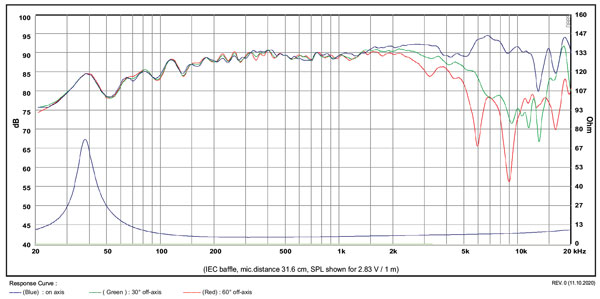
below is an example of low frequency driver impedance, Z(f). 

pl keep in mind, as reactive/resonating behavior of every driver, even the same brand/model, is different. it is also dependent of acoustic loading of the speaker box, never the same for every driver.

to get 4 Ohms total four driver spkr system I used 16 Ohms drivers, in parallel.

parallel connected drivers have also direct connection to low output amplifier impedance, to dampen resonances. 


PRO AUDIO SPEAKER

andy, how do you define driver impedance of 4 Ohms?

It's the nominal impedance within the usage freq. range.  For woofer, it is about up to 3KHz, after that the voice coil impedance kicks in to a gradual increase as freq. go up.  The plot you have above probably comes from the impedance plot of a woofer.  For tweeter, it is 4ohm almost flat up to 20KHz because obviously tweeter has to operate up to 20Khz.  But you will have the xover which has its own impedance.

to get 4 Ohms total four driver spkr system I used 16 Ohms drivers, in parallel

It is very difficult to find a 16ohm drivers.  Most are either 8ohm or 4ohm.  The one you show there is probably 8ohm woofer.

parallel connected drivers have also direct connection to low output amplifier impedance, to dampen resonances. 

Maybe for tube amplifiers but in which case the xover can use a zobel network to linearize the impedance curve.  Remember it is not just the impedance of the drivers, it is also the impedance of the xover too.

For solid state amplifiers which has very high damping factor so the impedance of the drivers probably won't be an issue.  So you won't have "dampen resonances" issues.

Here is the impedance plot of SB Satori Textreme 5in. woofer.  It stays pretty flat.