Convert XLR to TRS Headphone Cable Issue


My headphone's cable is hardwired with a male TRS termination to the headphone amp.  My new headphone amp (Musical Fidelity) has a combination output jack, either TRS or 3-pin XLR will fit .  I had a 3 wire (cable) 8' extension cable made that is terminated female TRS to connect with the headphone cable and XLR to plug into the amp/out fixture.  So, without the extension I got great music and very good soundstaging with the TRS headphone cable, but with the extension I lost the sound staging, sounds mono.  My headphone amp is "fully balanced"; however,  signal input is not balanced, but is by very good RCA interconnects from my CD player, if that matters...the maker of the cable is very aware of making sure the 3 wires connecting the XLR to the TRS are properly matched, but I cannot visually confirm unless I remove his shrink wrap.  I am not an electrical engineer by any means, but would appreciate thoughts and recommendations.

wncrob

My first post in this thread was poorly worded, so I’ve deleted it in favor of this:

wncrob

I had a 3 wire (cable) 8’ extension cable made that is terminated female TRS to connect with the headphone cable and XLR to plug into the amp/out fixture ...  My headphone amp is "fully balanced" ...

If your headphone extension cable has only three wires, it cannot be a balanced stereo cable. That would require at least four wires: a separate positive and negative for each channel.


Seems that you are only getting one channel - mono operation - which is why there is no soundstage.  For balanced operation in stereo (two channels) you need two XLR connections, not one.  It would help if we had the model number of the Musical Fidelity headphone amplifier.  My guess is that it has two XLR output sockets?

For balanced operation in stereo (two channels) you need two XLR connections, not one. 

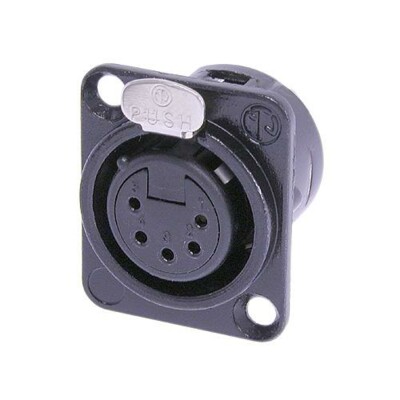
There are four- and five-pin XLR connectors that allow for balanced stereo operation in a single cable. My Moon 430HA offers a 4-pin jack as a connection option. Here’s a five-pin from Neutrik, which would allow shielding to be added to the four signal conductors:

The headphone amp is model MX-HPA...it was sold as new and heavily discounted.  Remember, I am not well educated on electrical matters...but have learned (I think) a lot in the past few days.  This amp is advertised as "Fully Balanced" with a pair of combo TRS/3-pin XLT output connectors...while the output connector to the headphone allows TRS or 3-pin XLR connectors, not a 4 pin outlet which balanced to balanced-designed headphone would seem to require....and my experience with a 3-pin XLR to TRS adapter cable (proper continuity confirmed) is that the XLR termination does not convey sound staging 9sounds mono), but with the TRS termination using the headphone cable without the adapter, I get full sound staging and musicality.  I'm beginning to think that there is an issue with the AMP. I should get proper sound staging with the 3-pin XLR connector irrespective of whether it was balanced or not...presumably the manufacturer has that figured out and properly wired everything...or not.  Its at the selling dealer today to be analyzed...will be interested to see if they can replicate my experience. So far, they have been excellent to deal with, but I doubt it can be "fixed" for XLR functionality, and a replacement is likely to have the same issues.  But I'm happy with TRS-only connection based upon what I heard before I got the 3-pin XLR to TRS adapter cable.  

When you are talking about balanced headphones and headphone amps, it's a marketing gimmick. There is no such thing. The people that make this stuff use the term balanced, put xlr connectors on the gear and hope you don't ask too many questions. Here's what's really going on. Any time you see the work balanced, insert the word bridged. A balanced headphone amp is really a bridged amp. Bridging combines 2 channels into one, so your headphone amp has 4 channels. Single ended stereo signal transfer requires 3 conductors. Left and right channels and a common ground. You have 4 power amps and 3 wires. The incoming signal is converted to balanced inside the headphone amp. After the conversion, you now have 2 signals and 2 separate grounds and can make use of all 4 channels. The "balanced" output for your headphones usually requires a TRRS connector, or something else that supports 4 conductors. If your headphones have a hardwired connection, you can't use them on the output that's labeled balanced, and you can't bridge the amp. Most people think that the TRRS headphone jack labeled balanced, is balanced. Its not. That's why there is no such thing. Headphones are just a really small pair of speakers. If you want to call headphones balanced, you have to call the speakers in your living room balanced as well. You can only use your headphones if you have a detachable cable. Now that the ground is separated from the bridging process, each speaker in the headphone gets its own ground, just like any other pair of speakers. They get to use the term balanced because the signal had to be split at the input to separate the common ground. So, if you want your headphones to work properly, you can't bridge the amp. 

The reason they try to hide this from you is there are some downsides to bridging amps. A bridged 2 channel amp sees half the resistance of a mono amp. For example, if you have an 8 ohm speaker, it becomes a 4 ohm load when you connect it to a bridged amp. You're forcing the amp to work twice as hard to drive the same load in unbridged mode. If you look at the specs on your headphone amp, you see the amp makes 2x the power in "balanced" mode. If your headphones are hard to drive, they may sound better with the amp bridged. If not, unbridged usually sounds better. If you want to use your amp in bridged mode, you'll need to get headphones that have a detachable cable, and a TRRS cable.