Take it on faith: A cease-and-desist letter to those who only believe in measurements


Faith is a firm belief in something for which there is no proof (https://www.merriam-webster.com/dictionary/faith). Faith is often considered to be distinct from and even contrary to science. I argue science is based on faith. Specifically, it is faith in the belief that measurements are always correct, and they alone can reveal the world around us. However, there is no evidence that this approach will always provide a correct and complete depiction of our environment.

I am not anti-science. In fact, I am all about science. I was a science major in college. I taught high school biology and chemistry. I employ science every day in my current career. I also use it to make decisions when it comes to audio, and I can point to a scientific basis behind my equipment decisions, speaker/listener locations and room treatment. I believe John Locke’s scientific method is a wonderful boon to mankind.  But although data may rule my life, I know that science has its limitations.

The scientific method is an empirical approach and relies on our eight senses or extensions thereof to measure phenomena, enabling us to better understand and control our environment. People who embrace this approach believe if something cannot be measured, it cannot exist. They have total faith in this approach and deny the credibility of others whose senses do not or cannot yield something in units. In essence, these disciples take it on faith that measurements are the only true way to make sense of the world. However, we just may not have developed the instrument that enables us to measure the event. Early digital is a good example of our senses superseding the limitations of our understanding of the technology and hence, our measurements. Other examples of this include our past beliefs that we could destroy mass, that the earth is flat, and the universe is not expanding. And cables and amplifiers all sound the same.

Others find their senses can reveal events that are not apparent to some and may not even be measurable. Some people can smell faint odors or feel a slight breeze that others cannot.  My wife can find a Petoskey stone on a beach out of thousands of rocks; I cannot see it even when I am standing over it. Different cables, fuses, amplifier topology, or cartridge design may or may not result in the same or even any data points and may or may not sound alike. But just because you cannot hear a difference nor measure a difference does not mean there is no difference. Beauty is in the eye of the beholder, just as good sound may be in their ear.

Some of us have at least as much faith in our ears as we do in our REW software and associated hardware. I start room setup with acoustic theory and then confirm with measurements, but the final placement is always a result of what sounds most pleasing. I would not know how to determine speaker toe-in using a microphone.

While I will always have to trust my senses, I am not handicapped by relying solely on those that are associated with a number.

 “…not everything that can be counted counts, and not everything that counts can be counted.” William Bruce Cameron, 1963

tcutter

Great post and i concur even if i am not a scientist with the opinion of one here...


To illustrate his point  i will post a google search about my Sansui Alpha 607i and a listening public test offer by Sansui as conclusion on their research about S.S. design and tube design : 


«It is true that Sansui’s goal for decades was to reproduce the sound of their best tube amplifier in a solid-state version, a task they reportedly accomplished before their bankruptcy. 

 
Sansui, a company renowned for its tube amplifiers in its early history, particularly the AU-111, transitioned to solid-state technology in the late 1960s. The engineers who designed their early solid-state amps often came from a tube design background, and the early solid-state amps were sometimes intentionally "voiced" to sound "tube-like". 
 
According to some sources, Sansui worked for over 30 years with the specific goal of exactly matching the sound of its 1965 tube masterpiece in a solid-state design, finally achieving this goal around the mid-1990s with their Alpha series, such as the AU-Alpha607 (AU-X701 in some markets). 
 
The goal was not necessarily to show that any tube amp and any solid-state amp sounded the same, but that a well-designed solid-state amp could achieve the specific, highly-regarded sonic signature of their classic tube model. This suggested that the "tube sound" was a result of specific design choices and implementation, rather than an inherent, unreplicable property of the vacuum tube technology itself. »
 
At the end Tube amplification is considered better than S.S. even by Sansui but they had demonstrated that they can produce design where the qualities of the two design meet together by incremental work and listening evaluations...
 
 Nowadays with class-d design even some tube great designer as atmasphere claim that S.S. class d can be as good as Tube design ...
 
Myself i like my Sansui alpha 607i whose headphone out  serving my AKG K340 beat in my opinion with a direct comparison in my home  the excellent tube headphone amp  Microzotl version two ( probably by lack of power to serve his complex design ) 
 

@mahgister 

I did not imply that "fringe" meant bad or not to be trusted. I meant that some of these theories or conjectures have not been experimentally verified and in some cases can't be experimentally validated.. They may eventually be accepted as settled physics but may also be discarded.

Time will tell.

i am sure you are sincere because you are polite, clear articulate and less  "reactive" than me...

 I welcome you here... I appreciate your background...

You must know i spoke French and only read science of philosophical books in English, i did not spoke it ever where i live... And i dont travel...

Once this is said i read a lot then i know the word "fringe" meaning...


«The word "fringe" is not inherently pejorative, but it is frequently used with a pejorative connotation, implying that a person, group, or idea is unimportant, eccentric, or outside the bounds of reasonable mainstream thought»

i reacted to this word recognized meaning....smiley

Word matter as much as intention... Sorry....


@mahgister 

I did not imply that "fringe" meant bad or not to be trusted. I meant that some of these theories or conjectures have not been experimentally verified and in some cases can't be experimentally validated.. They may eventually be accepted as settled physics but may also be discarded.

Time will tell.


@knownothing 

”Bringing this back to audio reproduction, some of the biggest unsettled arguments remain how different cable materials and configurations could change the sound we hear in our rooms, or how two amplifiers or DACs that measure nearly identically could sound different in our listening rooms, or how an amplifier or DAC that measure worse on the bench could actually sound better when experienced in our listening rooms.  And don’t even get me started on soundstage…

As you noted, the reductionist method works very well when the systems under consideration are uncomplicated and conducive to solving with simple experimental design. When we add complexity, controlling variables becomes much more difficult. In the case of evaluating hifi equipment, those variables include but are not limited to the quality of the supplied power and any power conditioning, the assemblage of equipment in the test, the configuration of the listening room, its materials and the placement of the speakers, and the seating position and listening skills of the person evaluating it.  

As commonly discussed here and elsewhere, the results of an evaluation of stereo equipment A versus B are only really valid for that particular “system”.  To get any statistically valid results requires careful ABX blind testing procedures and multiple listening “subjects” for both statistical power and to cover the potential variance in listening skills and hearing acuity. I have yet to see a really well designed “experiment” to test this because it is time consuming, and requires a large number of subjects tested one at a time in the sweet spot. This is still a reductionist approach, it is just a very complicated, and logistically and cost prohibitive in service of a point that has little transferable utility.

Based on all of this, the appeal among potential hifi shoppers to lean on bench test results derived with proven measurement equipment and protocols testing gear in complete isolation and calling that “Audio Science Review” is apparently immense. The alternatives are to trust the claims of manufacturers, the collective “wisdom” and experience on audio forums like this one, and/or trial and error testing at home in your listening room. Given the time and expense of the latter, there is ample motivation to disregard whole segments of products out of hand as voodoo, and take measurements as an insurance policy that an investment is well advised.

High end audio is for people with time and money. For many with limited time and a basic understanding of classical physics and electrical engineering and who just want to listen to music, a spec sheet is apparently plenty good.”


Well put. An excellent post. Just one small point I take issue with. Audio relies on more than just classical Physics. Without quantum mechanics, most electronic components wouldn’t exist.

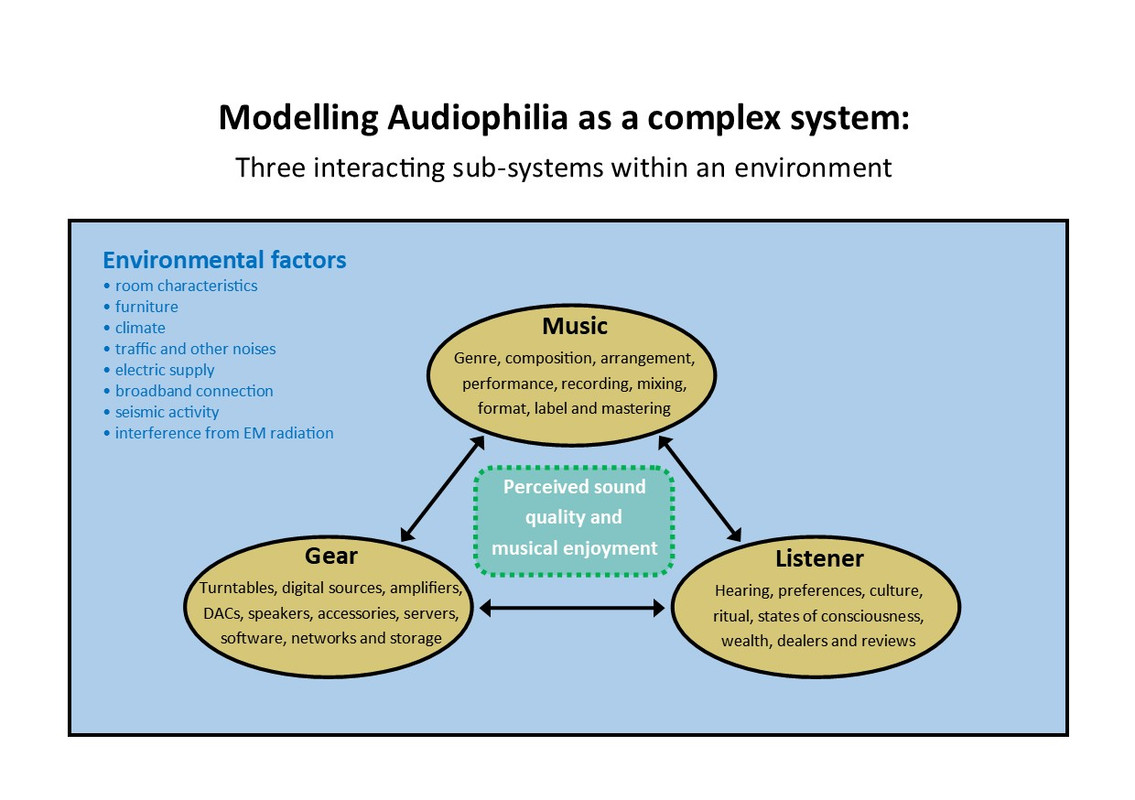
Even in the world of classical Physics, Maxwell’s equations indicate that things are a great deal more complex than the ASR lobby admit. Perhaps we need a whole system-based approach. Inspired by Morin’s work on complexity, I attempted to create a model of audiophilia. It seemed to me that it could be thought of as a complex system consisting of three interacting sub-systems, Music, Gear and Listener in an Environment.


This is not to deny the importance of the individual components of each sub-system and the environment, but to stress that the whole may be greater than the sum of the parts. There are more components than I have listed. The ones shown are just for illustration.


Audio is multi-disciplinary. Hopefully, the model illustrates why the more focussed approaches taken on hifi forums don’t capture the entire picture. It should be obvious why the qualitative and quantitative are both important. They should not be characterised as being subjective and objective. As I said before, there’s no good reason why the quantitative should be privileged over the qualitative. There's plenty of qualitiative data in Physics.