Tesla was not the first to recognize radio waves nor to do remote control with them.
Tesla did not invent radio.
Tesla is the father of using AC not electricity.
Tesla rejected and even made fun of Einsteins theories which included some early work on Quantum Mechanics not just relativity. My computer chips were designed using the principles of quantum mechanics.
You claim to be a study of science but you pick and choose and choose what you want to believe and don't seem to understand fundamentals.
We've taken care of everything The words you hear, the songs you sing The pictures that give pleasure to your eyes It's one for all, all for one We work together, common sons Never need to wonder how or why
We are the priests of the temples of syrinx Our great computers fill the hollowed halls We are the priests of the temples of syrinx All the gifts of life are held within these walls
Look around this world we made Equality our stock in trade Come and join the brotherhood of man What a nice contented world Let the banners be unfurled Hold the red star proudly high in hand
Yuvi, not believing in the existence of black holes really isn't that unreasonable. They are basically unimaginable, even if they are real. However, does your theory allow for supernovas? Please don't tell me to look at some video. Kindly give a straight forward answer to a straight forward question. Thank You.
The problem, however, is that in even the best computer simulations, the shock wave isn’t powerful enough on its own to break through the dense layers of superheated gas that envelops the core.
In the models, the shock wave stalls as if muffled by a blanket and the supernova explosion never occurs.
In the late 1980s, scientists began experimenting with the idea that ghostly subatomic particles known as neutrinos might provide the extra power boost needed to complete the blast.
Neutrinos have no charge and are nearly massless. They are produced in vast quantities during the final stages of a massive star’s life and stream out of the star’s inner core. It was thought that these escaping particles might carry enough energy out of the core to the star’s outer layers to complete the explosion.
But even when scientists incorporated the outflow of neutrinos into their computer simulations, it still wasn’t enough to produce consistent supernovas.
Space.com
It’s the celestial equivalent of a horror movie villain—a star that wouldn’t stay dead.
An international team of astronomers including Carnegie’s Nick Konidaris and Benjamin Shappee discovered a star that exploded multiple times over a period of 50 years. The finding, published by Nature, completely confounds existing knowledge of a star’s end of life, and Konidaris’ instrument-construction played a crucial role in analyzing the phenomenon.
In September 2014, the intermediate Palomar Transient Factory team of astronomers detected a new explosion in the sky, iPTF14hls.
The light given off by the event was analyzed in order to understand the speed and chemical composition of the material ejected in the explosion.
This analysis indicated that the explosion was what’s called a type II-P supernova, and everything about the discovery seemed normal. Until, that is, a few months later when the supernova started getting brighter again.
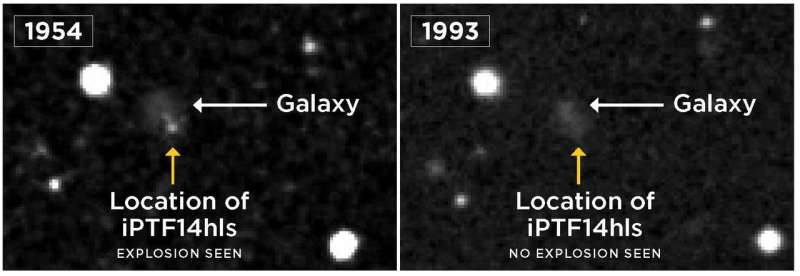
Type II-P supernovae usually remain bright for about 100 days. But iPTF14hls remained bright for more than 600! What’s more, archival data revealed a 1954 explosion in the exact same location.
An image taken by the Palomar Observatory Sky Survey reveals a possible explosion in the year 1954 at the location of iPTF14hls (left), not seen in a later image taken in 1993 (right). Supernovae are known to explode only once, shine for a few months and then fade, but iPTF14hls experienced at least two explosions, 60 years apart. Credit: Adapted from Arcavi et al. 2017, Nature. POSS/DSS/LCO/S. Wilkinson.
It turned out that somehow this star exploded more than half a century ago, survived, and exploded again in 2014.
"This supernova breaks everything we thought we knew about how they work," said lead author Iair Arcavi of University of California Santa Barbara and Las Cumbres Observatory.
Before I give you a simpler explanation for Supernovas, just know that there are observations coming back from space that defy standard models, and show stars, and supernovas that simply should not exist.
You must have a verified phone number and physical address in order to post in the Audiogon Forums. Please return to Audiogon.com and complete this step. If you have any questions please contact Support.