Do I need an expensive digital cable?


I have been using a fairly inexpensive optical cable to connect my CD transport to my Moon 280D streamer. I was told that an SPDIFcoax cable would sound better. For an experiment I purchased an inexpensive Pangea coax cable. It didn't sound at all because its terminator ends did not fit snugly in my equipment. I consulted chatgbt who often gives me audio advice. It advised that for the short run of 1 meter, an RCA interconnect would work. It did. And sounded much better than the optical. Chatgbt said that RCA interconnect was good enough.

Now, there is a twist to this story that might make those doubters think twice. A digital cable carries packets of information that are rechecked to assure that the streamer is recieving correct information. There is the timing concern, though. But my Moon 280D has an asynchronous DAC with a clock as part of the DAC. Any information sent by my transport, whether it is clocked by the transport or not, will go through the Moon's asynchronous DAC's clock. So ;there shouldn't be a timing problem. Should there?

Can anyone make a case that I should buy a "better" coax cable?

audio-b-dog

Here is chatgpt's take on the issue:


In digital audio there are two fundamentally different ways to represent the music waveform. PCM and DSD are not just different file types—they encode sound using completely different strategies.


PCM (Pulse Code Modulation)
https://samplerateconverter.com/sites/default/files/u1/sample-rate.png

https://www.researchgate.net/publication/269935208/figure/fig1/AS%3A669473463881747%401536626320857/Pulse-Code-Modulation-PCM-audio-an-analogical-signal-is-represented-by-25-samples-with.png

https://techterms.com/img/xl/pcm_1531.png

4

PCM is how CDs, most streaming, and most studio recordings work.

How it stores sound

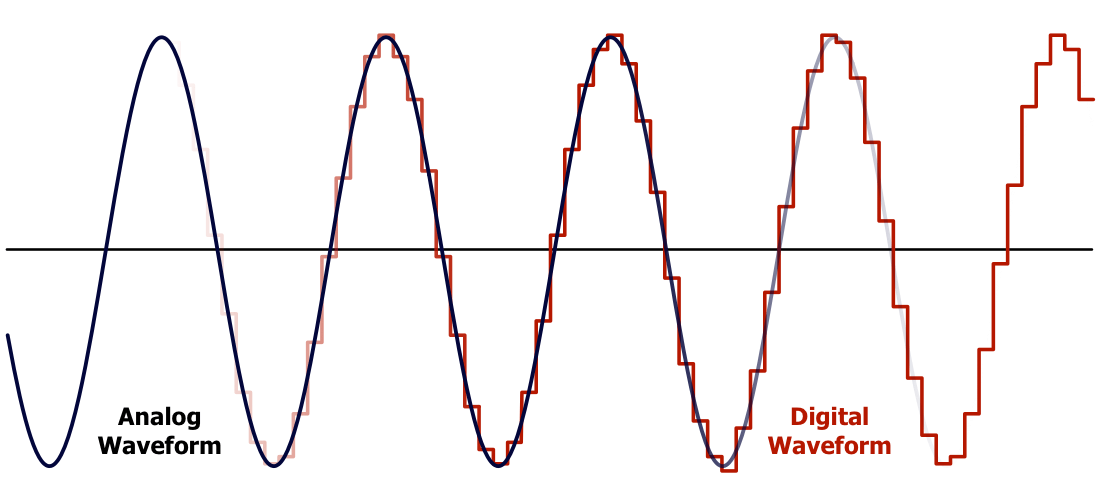
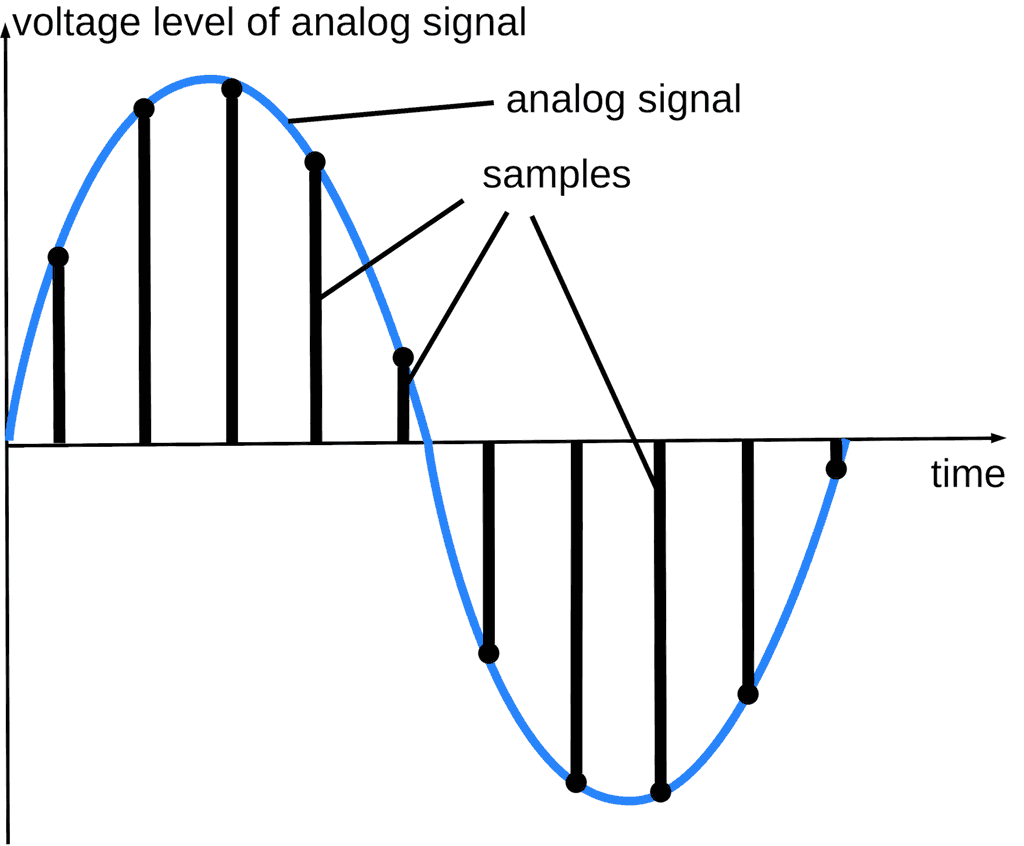
  1. The analog waveform is measured at regular time intervals (samples).

  2. Each sample stores an exact amplitude value using a multi-bit number.

Example:

  • CD: 44.1 kHz sample rate, 16-bit

  • Hi-res: 96 kHz or 192 kHz, 24-bit

Think of it as a series of snapshots of the waveform.

Two parameters determine accuracy

1. Sample rate (time resolution)
How often the waveform is measured.

  • 44.1 kHz = 44,100 measurements per second

  • 96 kHz = 96,000 measurements per second

Higher sampling captures higher frequencies and smoother transients.

2. Bit depth (amplitude resolution)

  • 16-bit → 65,536 possible levels

  • 24-bit → 16.7 million levels

Higher bit depth gives:

  • lower noise floor

  • better micro-dynamics

  • smoother decay of notes

That “fleshed-out piano decay” you mentioned earlier is largely due to greater bit depth and lower quantization noise.


DSD (Direct Stream Digital)
https://www.psaudio.com/cdn/shop/articles/PCM-header.png?v=1682695819

https://upload.wikimedia.org/wikipedia/commons/thumb/e/e7/Pulse_density_modulation.svg/330px-Pulse_density_modulation.svg.png

https://upload.wikimedia.org/wikipedia/commons/thumb/6/66/PCM-vs-DSD.svg/250px-PCM-vs-DSD.svg.png

4

DSD works completely differently.

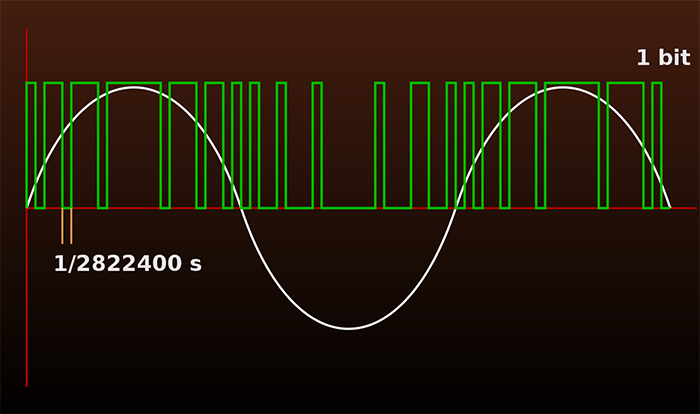
Instead of storing amplitude values, it stores a stream of single-bit pulses.

Each sample is only:

1 bit — either up or down

But the sampling rate is extremely high.

Typical DSD rates:

  • DSD64: 2.8224 MHz

  • DSD128: 5.6 MHz

  • DSD256: 11.2 MHz

That is 64× the CD sample rate.

How it represents sound

The waveform is encoded as pulse density:

  • Many “1s” = signal going up

  • Many “0s” = signal going down

The density of pulses forms the waveform.

Think of it like a swarm of bees outlining a shape rather than drawing a line.


The Key Philosophical Difference

PCM

  • Measures exact amplitude values

  • Moderate sampling rate

  • Multi-bit precision

DSD

  • Measures change direction

  • Extremely high sampling rate

  • Only 1-bit precision


Why Some Audiophiles Prefer DSD

Supporters say DSD sounds:

  • smoother

  • more “analog-like”

  • less etched

Reasons often cited:

  1. Very gentle filtering

  2. No multi-bit quantization steps

  3. Noise pushed into ultrasonic frequencies

But there’s a catch.

Most recordings today that end up as DSD are actually:

Recorded → PCM workstation → converted to DSD

So the purity is often partly theoretical.


Why Studios Mostly Use PCM

PCM is far easier for:

  • editing

  • mixing

  • equalization

  • compression

  • multitrack recording

DSD editing is extremely difficult. Many DSD recordings are actually converted to PCM during editing and then converted back.


A Practical Audiophile Take (for your system)

Given your Moon 280D DAC, high-end analog front end, and the kind of listening you describe:

  • Good 24-bit PCM (96 or 192 kHz) can sound astonishingly natural.

  • Native DSD recordings can have a very smooth, fluid character.

But the recording quality matters far more than the format.

A great 24/96 PCM recording will easily beat a mediocre DSD one.


One Interesting Historical Note

SACD (DSD) was developed by
Sony and
Philips

partly as a successor to the CD and partly to make copying harder.

Ironically, PCM high-resolution downloads ended up dominating instead.


If you're interested, I can also explain something that puzzles many audiophiles:

Why DSD sometimes sounds smoother even when the source started as PCM.

The explanation involves noise shaping and filtering, and it's quite interesting

@audio-b-dog 

I think SACD uses DSD, butr also a higher sampling rate, so it's not apples to apples comparing a PCM CD to a DSD SACD

It is certainly not apples to apples.  DSD is designed to be a far better delivery format.  SACD uses DSD at 64 times the sampling rate of CD, often written DSD64.

Sony and Philips created SACD as the successor to CD. It is only in North America that the format failed to take off.

SACDs have a much higher density layer that can hold several SACD versions. 

Nearly all SACDs have a 5.1 channel version, and a 2 channel version.

Note that most SACDs have a standard Redbook CD layer that can be read by any CD player.  These are called hybrid SACDs.

If you really want to compare formats, I'd recommend some recent releases from the Norwegian label 2l.no.  They include a hybrid SACD with multiple versions and a CD layer, plus a Pure Audio Blu-ray disk with multiple high resolution PCM formats and even Dolby Atmos, all in the same box.  Grammy winning stuff.

In Oz, we have an advert running for the never never land (Northern Territory) with the line "if you never ever go, you'll never ever know".

@audio-b-dog 

ChatGPT’s diagram of how DSD works is very misleading.  Even worse than Qobuz’s explanation of high-resolution!

For example, where the ChatGPT waveform is flat, there should be an equal number of alternating 0 and 1 bits, the exact opposite of what the diagram shows.

It is very simple.  Keep a running total of where the sound pressure is up to. Take a sample.  If it is higher than your running total, add a 1 bit to the stream and your running total.  If it is lower, add a 0 bit to the stream and reduce your running total by 1.

By the way, every 64 samples, your running total equals the CD 16-bit number at that point.  You can exactly calculate the CD data from the DSD stream, but the reverse does not apply.

@richardbrand 

Could you give me some real world examples of what you're talking about? My Moon 280D streamer handles both DSD and PCM. I also have both Tidal and Qobuz loaded. So, you could probably give me any piece of music to listen to and compare what is happening. Several times I have listened to the same album on Hi Rez Qobuz and Tidal. I'm trying to choose between the two. So far, I think I'm favoring Qobuz. My choice will only be partly on the sound. I also listen to a lot of classical music and jazz, and there seems to be more to choose from on Qobuz. But I am also interrested in sound differences. 

All of this takes time, of course, and concentration, both of which are in short supply. But I intend on comparing my CD player against streaming, now that I have a somewhat decent (passable?) digital coax cable. My initial impression is that CD often sounds better, but I know this does not make logical sense. 

This is all very interesting, folks.

To complicate matters further, most SACD transports do not export native DSD to a DAC due to imbecilic copyright protections that exclusively inconvenience honest users. In practice, SACD transports only output  DSD natively to DACs of the same brand through a secure proprietary interface, essentially making the transport + DAC the equivalent of a SACD player.

Otherwise, sadly, your SACD transport downconverts your DSD signal to PCM before sending it to your DAC. Manufacturers seldom brag about this, or any up / downsampling or format conversions done in the digital domain for that matter. What audiophiles don’t know can’t hurt them.

The idea is to make it too difficult for non-expert users to capture (and, presumably, pilfer) the DSD stream.

Now, Accuphase’s acclaimed duet of DP-1000 transport ($24,975) and DC-1000 DAC ($24,975) plays SACD end-to-end. No shenanigans there; you get exactly what you thought you were getting.

Accuphase makes amazing gear, but it is not inexpensive. A more down-to-earth alternative is PRC-made gear. DRM? What’s DRM? HAHAHA THOSE SILLY AMERICANS!!!

That’s how it goes with 2-channel audio. DSD over HDMI is a different ball of wax.