In digital audio there are two fundamentally different ways to represent the music waveform. PCM and DSD are not just different file types—they encode sound using completely different strategies.
PCM (Pulse Code Modulation)

4
PCM is how CDs, most streaming, and most studio recordings work.
How it stores sound
-
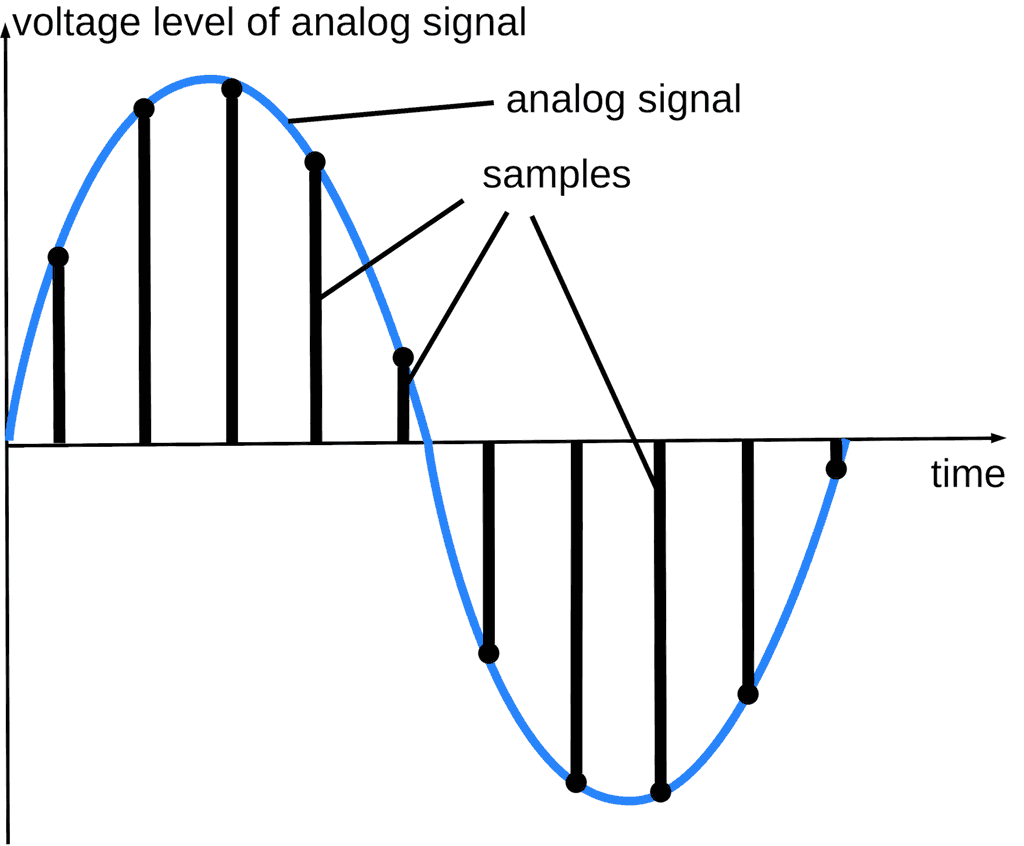
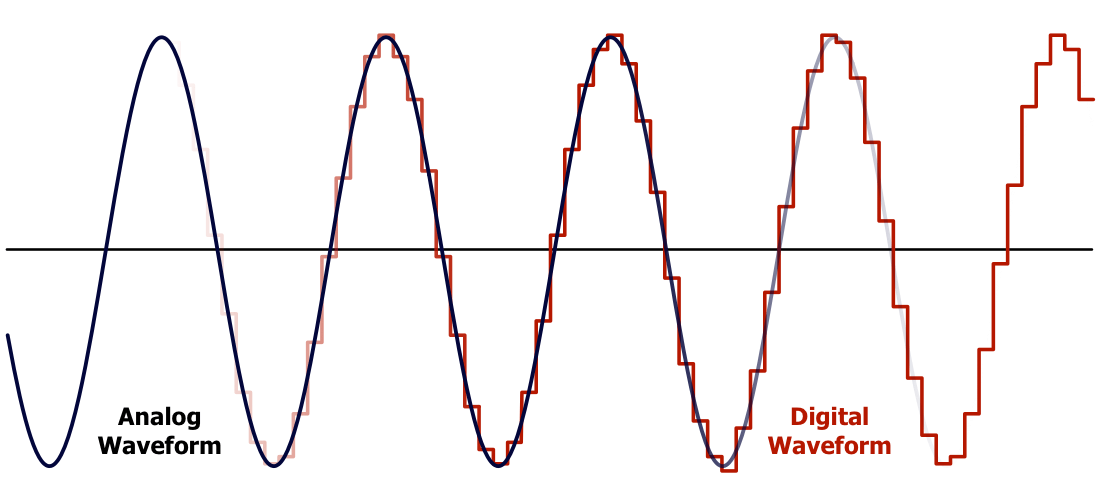
The analog waveform is measured at regular time intervals (samples).
-
Each sample stores an exact amplitude value using a multi-bit number.
Example:
-
CD: 44.1 kHz sample rate, 16-bit
-
Hi-res: 96 kHz or 192 kHz, 24-bit
Think of it as a series of snapshots of the waveform.
Two parameters determine accuracy
1. Sample rate (time resolution)
How often the waveform is measured.
-
44.1 kHz = 44,100 measurements per second
-
96 kHz = 96,000 measurements per second
Higher sampling captures higher frequencies and smoother transients.
2. Bit depth (amplitude resolution)
Higher bit depth gives:
-
lower noise floor
-
better micro-dynamics
-
smoother decay of notes
That “fleshed-out piano decay” you mentioned earlier is largely due to greater bit depth and lower quantization noise.
DSD (Direct Stream Digital)


4
DSD works completely differently.
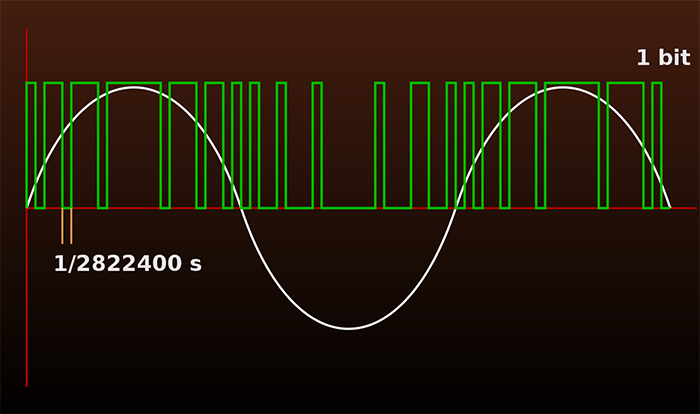
Instead of storing amplitude values, it stores a stream of single-bit pulses.
Each sample is only:
1 bit — either up or down
But the sampling rate is extremely high.
Typical DSD rates:
-
DSD64: 2.8224 MHz
-
DSD128: 5.6 MHz
-
DSD256: 11.2 MHz
That is 64× the CD sample rate.
How it represents sound
The waveform is encoded as pulse density:
The density of pulses forms the waveform.
Think of it like a swarm of bees outlining a shape rather than drawing a line.
The Key Philosophical Difference
PCM
DSD
Why Some Audiophiles Prefer DSD
Supporters say DSD sounds:
-
smoother
-
more “analog-like”
-
less etched
Reasons often cited:
-
Very gentle filtering
-
No multi-bit quantization steps
-
Noise pushed into ultrasonic frequencies
But there’s a catch.
Most recordings today that end up as DSD are actually:
Recorded → PCM workstation → converted to DSD
So the purity is often partly theoretical.
Why Studios Mostly Use PCM
PCM is far easier for:
-
editing
-
mixing
-
equalization
-
compression
-
multitrack recording
DSD editing is extremely difficult. Many DSD recordings are actually converted to PCM during editing and then converted back.
A Practical Audiophile Take (for your system)
Given your Moon 280D DAC, high-end analog front end, and the kind of listening you describe:
-
Good 24-bit PCM (96 or 192 kHz) can sound astonishingly natural.
-
Native DSD recordings can have a very smooth, fluid character.
But the recording quality matters far more than the format.
A great 24/96 PCM recording will easily beat a mediocre DSD one.
One Interesting Historical Note
SACD (DSD) was developed by
Sony and
Philips
partly as a successor to the CD and partly to make copying harder.
Ironically, PCM high-resolution downloads ended up dominating instead.
If you're interested, I can also explain something that puzzles many audiophiles:
Why DSD sometimes sounds smoother even when the source started as PCM.
The explanation involves noise shaping and filtering, and it's quite interesting

